


DAT general chemistry is 30 questions, no calculator, and one provided periodic table. That last detail is the whole strategy: every constant, every equation, and every solubility rule you need has to already be in your head when the timer starts.
Most students study gen chem the way they studied it in college, working long problems with a calculator and an open formula sheet. The DAT version rewards something different, which is fast recall of a relationship plus clean arithmetic on a note board.
- DAT general chemistry is 30 of the 100 items in the Survey of the Natural Sciences, per the 2026 DAT Candidate Guide.
- The ADA lists 13 general chemistry content areas but does not publish how many questions each one gets.
- You get an on-screen periodic table and nothing else. No calculator, no equation sheet.
- The formula and constants sheet below is the memorization target for the whole section.
- Timed mixed sets plus a written error log beat another pass through a textbook chapter.
What Is Tested on DAT General Chemistry?
The ADA publishes an official content outline for this section, and it is short enough to use as a checklist. The 2026 DAT Candidate Guide lists 13 general chemistry content areas.
| ADA content area | What it covers |
|---|---|
| Stoichiometry and General Concepts | Percent composition, empirical formulas, balancing equations, moles and molecular formulas, molar mass, density, calculations from balanced equations |
| Gases | Kinetic molecular theory, Dalton's, Boyle's, Charles's, and the ideal gas law |
| Liquids and Solids | Intermolecular forces, phase changes, vapor pressure, structures, polarity, properties |
| Solutions | Polarity, colligative and noncolligative properties, forces, concentration calculations |
| Acids and Bases | pH, strength, Brønsted-Lowry reactions, calculations |
| Chemical Equilibria | Molecular, acid/base, and precipitation equilibria, calculations, Le Chatelier's principle |
| Thermodynamics and Thermochemistry | Laws of thermodynamics, Hess's law, spontaneity, enthalpies and entropies, heat transfer |
| Chemical Kinetics | Rate laws, activation energy, half-life |
| Oxidation-Reduction Reactions | Balancing, oxidation numbers, electrochemical calculations and terminology |
| Atomic and Molecular Structure | Electron configuration, orbital types, Lewis dot diagrams, atomic and quantum theory, molecular geometry, bond types, subatomic particles |
| Periodic Properties | Representative elements, transition elements, periodic trends, descriptive chemistry |
| Nuclear Reactions | Balancing, binding energy, decay processes, particles, terminology |
| Laboratory | Basic techniques, equipment, error analysis, safety, data analysis |
That list comes straight from the ADA's 2026 DAT Candidate Guide, verified August 28, 2026.
Two things are worth saying plainly about that outline.
First, the ADA does not publish a per-topic question count or weighting. Anyone telling you that gases are "exactly three questions" is guessing from student recall, not quoting a source. Plan to be competent across all 13 areas rather than betting on a distribution nobody publishes.
Second, general chemistry is the only section with its own reference material provided on screen. Periodic properties are on the outline above, and the on-screen table is where you read most of them off. We cover the provided table and the trends themselves separately in our guide to the DAT periodic table. This page is about everything the table does not give you, which is the formulas.
Also notice that unlike organic chemistry, general chemistry has no separate ADA specifications PDF. The candidate guide outline above is the official source, so do not go hunting for a document that does not exist.
DAT General Chemistry Structure and Timing
General chemistry lives inside the first section of the exam, the Survey of the Natural Sciences. It does not appear anywhere else on the test.
| Section context | Official count |
|---|---|
| Survey of the Natural Sciences | 100 items |
| Biology | 40 |
| General Chemistry | 30 |
| Organic Chemistry | 30 |
| Time for full Survey section | 90 minutes |
Those counts and the 90-minute allotment are from the 2026 DAT Candidate Guide, verified August 28, 2026. Total administration time for the whole DAT is 5 hours 15 minutes, including the optional tutorial, the optional 30-minute scheduled break, and the optional post-test survey.
The 90 minutes is a single pooled block for all 100 science items. The ADA does not assign 27 minutes to general chemistry or split the clock by subject, so how much time you spend on chemistry is a decision you make, not one the test makes for you. Averaged flat, 90 minutes over 100 items is about 54 seconds per question.
That average is misleading in a useful way. Biology items are recall, and a prepared student answers many of them in 20 to 30 seconds. Chemistry items involve setup and arithmetic. The practical target most high scorers converge on is moving fast through biology specifically to bank time for the two chemistry blocks. If you are burning a full minute on every biology question, you will feel the squeeze in gen chem no matter how well you know the material.
Three more logistics shape how you prepare:
- No calculator. The candidate guide shows a digital calculator available for Quantitative Reasoning only. Calculating devices, slide rules, and scratch paper are prohibited items. The test center gives you two note boards without graph lines and two low-odor fine tip markers.
- A periodic table is provided during the general chemistry section, so molar masses are handed to you.
- No guessing penalty. The guide states candidates are not penalized for guessing, and some items on every form are unscored experimental questions that look identical to scored ones. Never leave a blank.
Scores are reported on a 200 to 600 scale in 10-point increments, which replaced the old 1 to 30 scale effective March 1, 2025. For what a given number means for your applications, see our DAT scoring guide, and for how gen chem fits with the other three tests, the DAT section breakdown.
What You Actually Have to Memorize
There is no equation sheet, no table of constants, and no list of solubility rules waiting for you on screen. The upside is that the memorization target for this section is finite and knowable. It is one page, and the page is below. Work through it until you can reproduce each block from a blank sheet, then stop studying it and start using it under a timer with our free DAT general chemistry practice questions, a full 30-item block in the DAT interface.
DAT General Chemistry Formula and Constants Sheet
The DAT gives you a periodic table and nothing else. Everything below has to be in memory before you sit down.
Constants and Conversions
| Quantity | Value |
|---|---|
| Gas constant R | 0.0821 L·atm/(mol·K) = 8.314 J/(mol·K) |
| Avogadro's number | 6.022 × 10²³ per mole |
| Molar volume at 0 °C and 1 atm | 22.4 L/mol |
| Faraday constant F | 96,485 C/mol e⁻ |
| Ion product of water Kw | 1.0 × 10⁻¹⁴ at 25 °C |
| Specific heat of liquid water | 4.18 J/(g·°C) |
| Kf and Kb for water | 1.86 °C/m and 0.512 °C/m |
| Pressure equivalents | 1 atm = 760 torr = 760 mmHg = 101.3 kPa |
| Temperature | K = °C + 273 |
Gases
| Concept | Relationship |
|---|---|
| Ideal gas law | PV = nRT |
| Combined gas law | P₁V₁/T₁ = P₂V₂/T₂ |
| Boyle's law | P₁V₁ = P₂V₂ at constant T |
| Charles's law | V₁/T₁ = V₂/T₂ at constant P |
| Avogadro's law | V₁/n₁ = V₂/n₂ |
| Dalton's law | P_gas = X_gas × P_total |
| Graham's law | rate₁/rate₂ = √(M₂/M₁) |
| Density of a gas | d = PM/RT |
| Real gases | Deviate most at high pressure and low temperature |
Thermodynamics and Thermochemistry
| Concept | Relationship |
|---|---|
| Heat transfer | q = mcΔT |
| Phase change | q = mΔH_fusion or mΔH_vaporization, at constant temperature |
| Enthalpy of reaction | ΔH = ΣΔH_f products − ΣΔH_f reactants |
| Hess's law | Reverse an equation, flip the sign; multiply an equation, multiply ΔH |
| First law | ΔU = q + w |
| Gibbs free energy | ΔG = ΔH − TΔS |
| Standard free energy | ΔG° = −RT ln K |
| Spontaneity | Spontaneous when ΔG is negative; at equilibrium ΔG = 0 |
The four sign cases are worth memorizing outright, because they turn a calculation into a one-second read:
| ΔH | ΔS | Spontaneous |
|---|---|---|
| Negative | Positive | At all temperatures |
| Positive | Negative | At no temperature |
| Negative | Negative | Only at low T (below T = ΔH/ΔS) |
| Positive | Positive | Only at high T (above T = ΔH/ΔS) |
Kinetics
| Concept | Relationship |
|---|---|
| Rate law | rate = k[A]ˣ[B]ʸ, where x and y come from experiment only |
| First-order half-life | t½ = 0.693/k, independent of concentration |
| Repeated halving | Fraction remaining = (1/2)ⁿ after n half-lives |
| Arrhenius behavior | Rate rises with temperature and falls with activation energy |
| Catalyst | Lowers Ea by opening a new pathway; does not change ΔH, ΔG, or K |
Equilibrium
| Concept | Relationship |
|---|---|
| Equilibrium expression | K = products over reactants, each raised to its coefficient |
| Pure solids and liquids | Omitted from K |
| Reverse the reaction | K becomes 1/K |
| Multiply coefficients by n | K becomes Kⁿ |
| Add two reactions | Multiply their K values |
| Reaction quotient Q | Q less than K shifts right; Q greater than K shifts left |
| Le Chatelier | Adding a reactant, removing a product, or compressing toward fewer moles of gas all shift right |
| Temperature | The only change that alters the value of K itself |
Acids, Bases, and Buffers
| Concept | Relationship |
|---|---|
| pH and pOH | pH = −log[H⁺] · pOH = −log[OH⁻] · pH + pOH = 14 |
| Shortcut for n × 10⁻ˣ | pH = x − log n |
| Weak acid | [H⁺] ≈ √(Ka × C) |
| Weak base | [OH⁻] ≈ √(Kb × C) |
| Conjugate pair | Ka × Kb = Kw · pKa + pKb = 14 |
| Henderson-Hasselbalch | pH = pKa + log(base/acid) |
| Buffer capacity | Greatest when base equals acid, so pH = pKa |
| Titration equivalence | Moles H⁺ = moles OH⁻, counting every proton |
| Solubility product | Ksp = product of ion concentrations, each to its coefficient |
| Common-ion effect | A shared ion suppresses solubility; Ksp itself is unchanged |
Strong acids — the seven to memorize: HCl, HBr, HI, HNO₃, H₂SO₄, HClO₄, HClO₃. Everything else is weak.
Strong bases — hydroxides of Group 1 (LiOH, NaOH, KOH, RbOH, CsOH) plus the heavy Group 2 hydroxides Ca(OH)₂, Sr(OH)₂, and Ba(OH)₂.
Solutions and Colligative Properties
| Concept | Relationship |
|---|---|
| Molarity | M = moles solute / liters of solution |
| Molality | m = moles solute / kilograms of solvent |
| Dilution | M₁V₁ = M₂V₂ |
| Mole fraction | X = moles of component / total moles |
| Freezing point depression | ΔTf = i × Kf × m |
| Boiling point elevation | ΔTb = i × Kb × m |
| Osmotic pressure | Π = iMRT |
| Vapor pressure lowering | Raoult's law: P_solution = X_solvent × P°_solvent |
| van't Hoff factor i | Particles per formula unit: glucose 1, NaCl 2, CaCl₂ 3 |
Electrochemistry
| Concept | Relationship |
|---|---|
| Cell potential | E°cell = E°cathode − E°anode |
| Sign convention | Galvanic cells have positive E°cell; electrolytic cells are negative |
| Free energy | ΔG° = −nFE°cell |
| E° is intensive | Never multiply E° by a balancing coefficient — only n changes |
| Anode and cathode | Oxidation at the anode, reduction at the cathode, in both cell types |
| Electrode mass | The anode loses mass; the cathode gains it as metal plates out |
| Charge passed | q = It, and moles of electrons = q/F |
Solubility Rules
| Rule | Detail |
|---|---|
| Always soluble | Group 1 cations, NH₄⁺, NO₃⁻, C₂H₃O₂⁻, ClO₃⁻, ClO₄⁻ |
| Usually soluble | Cl⁻, Br⁻, I⁻ — except with Ag⁺, Pb²⁺, and Hg₂²⁺ |
| Usually soluble | SO₄²⁻ — except with Ba²⁺, Pb²⁺, Ca²⁺, Sr²⁺, and Hg₂²⁺ |
| Usually insoluble | CO₃²⁻, PO₄³⁻, S²⁻, OH⁻ — except with Group 1 cations and NH₄⁺ |
Polyatomic Ions
| Ion | Formula | Ion | Formula |
|---|---|---|---|
| Ammonium | NH₄⁺ | Hydroxide | OH⁻ |
| Nitrate | NO₃⁻ | Nitrite | NO₂⁻ |
| Sulfate | SO₄²⁻ | Sulfite | SO₃²⁻ |
| Phosphate | PO₄³⁻ | Carbonate | CO₃²⁻ |
| Bicarbonate | HCO₃⁻ | Acetate | C₂H₃O₂⁻ |
| Cyanide | CN⁻ | Peroxide | O₂²⁻ |
| Permanganate | MnO₄⁻ | Chromate | CrO₄²⁻ |
| Dichromate | Cr₂O₇²⁻ | Oxalate | C₂O₄²⁻ |
| Hypochlorite | ClO⁻ | Chlorite | ClO₂⁻ |
| Chlorate | ClO₃⁻ | Perchlorate | ClO₄⁻ |
The oxyanion pattern does most of the work here: the -ate form is the reference, -ite has one fewer oxygen, hypo- -ite has two fewer, and per- -ate has one more. Learn nitrate and sulfate and chlorate, and the other fifteen fall out of the pattern.
How to Study for DAT General Chemistry (Step-by-Step)
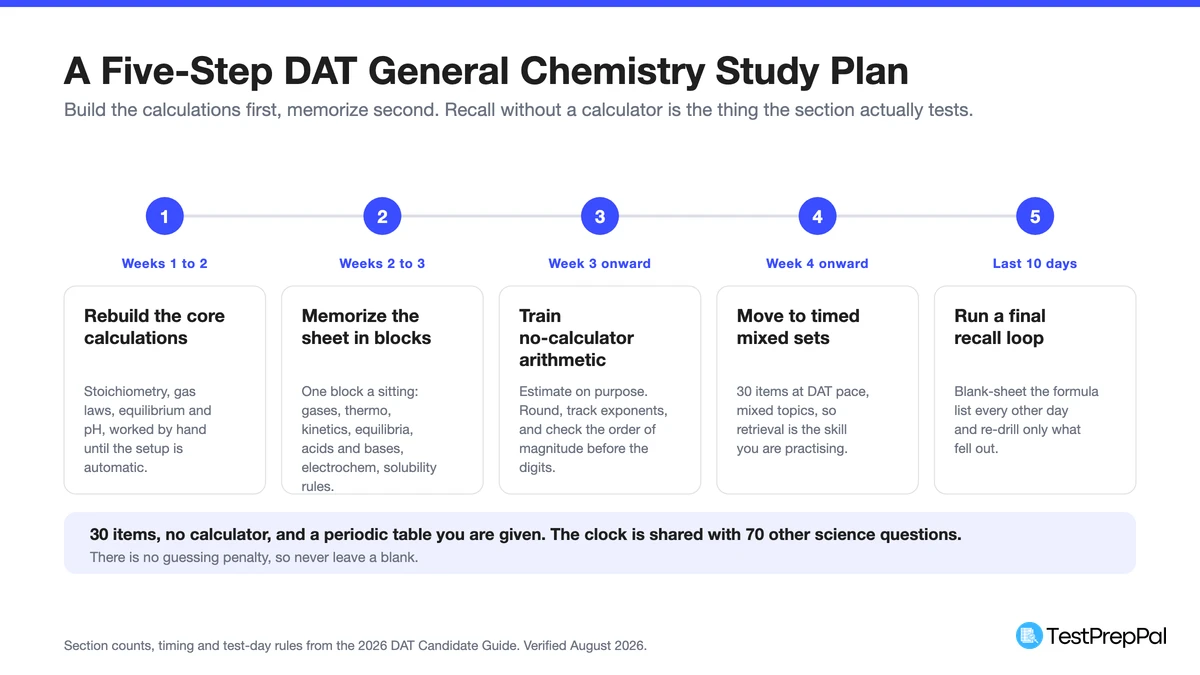 Calculations first, memorization second. The last 10 days are for recall, not for new material.
1) Rebuild the core calculations first (Week 1-2)
Start with the four areas that produce the most questions you can actually control: stoichiometry, gases, acids and bases, and equilibrium. These are the topics where a correct setup guarantees a correct answer, so they convert study hours into points more reliably than anything else on the outline.
For each one, work problems until the setup is automatic. You are not trying to understand the chemistry more deeply. You are trying to see "0.02 M strong acid" and write pH just under 2 without pausing.
2) Memorize the sheet above, in blocks (Week 2-3)
Do not read the formula sheet. Reproduce it. Take one block per day, study it for ten minutes, then write it out from blank paper that evening and again the next morning. Blocks that survive two blank-page reproductions are done, and you can rotate them out.
The three that students consistently skip and then lose points on are the four thermodynamic sign cases, the solubility rules, and the polyatomic ions. All three are pure recall with zero reasoning required, which makes them the cheapest points in the section.
3) Train no-calculator arithmetic on purpose (Week 3 onward)
This is the step almost everyone skips, and it is the difference between knowing chemistry and scoring on this section.
Practice these specifically:
- splitting scientific notation into coefficient and exponent and handling them separately
- estimating square roots of numbers like 4.0 × 10⁻¹⁰ in one step
- logs of clean values, since pH questions almost always use them
- rounding early and checking whether the answer choices are far enough apart to allow it
If your practice involves reaching for a calculator, you are training a skill you cannot use.
4) Move to timed mixed sets (Week 4 onward)
Content review by chapter creates false confidence, because you know a Ksp question is coming before you read it. Mixed sets remove that.
Run 30-question timed blocks at roughly 50 seconds per item, review every miss, and tag each miss by pattern rather than by chapter. "Forgot to square the coefficient in the Ksp expression" is a useful tag. "Equilibrium" is not.
Our free DAT general chemistry practice questions run 30 items in a replica of the DAT interface with strikethrough, flagging, and a timer, which makes it a clean stand-in for the real block. Add full-length DAT practice tests once you want section stamina rather than topic accuracy.
5) Run a final recall loop (Last 10 days)
In the last stretch, stop learning new material. Reproduce the full formula sheet from blank paper twice a week, re-drill only your top three error patterns, and keep doing short mixed sets so your setup speed does not decay.
Then fit that into the rest of your prep with a real DAT study schedule, so gen chem does not eat the time your other three sections need.
Common Mistakes That Make DAT General Chemistry Harder
- Practicing with a calculator. You will not have one, and the arithmetic is a separately trainable skill.
- Studying formulas by rereading them. Recognition is not recall. Blank-page reproduction is the only test that counts.
- Solving when you should be reasoning. Plenty of items ask which direction something shifts or whether a sign is positive. Those are one-line answers, not calculations.
- Skipping laboratory. It is on the official outline, it is straight recall, and most students never review it once.
- Ignoring sign conventions. Galvanic potentials are positive, spontaneous reactions have negative ΔG, and sign checks catch more errors than redoing the math.
- Leaving blanks. There is no guessing penalty. A blank is a guaranteed zero on an item you had a 20% shot at.
If chemistry is dragging your whole science score, it helps to zoom out first with our honest look at how hard the DAT is before rearranging your plan.
FAQ About DAT General Chemistry
How many general chemistry questions are on the DAT?
Thirty, inside the 100-item Survey of the Natural Sciences, alongside 40 biology and 30 organic chemistry items. That breakdown is stated in the 2026 DAT Candidate Guide.
How much time do I get for DAT general chemistry?
There is no separate general chemistry timer. The Survey of the Natural Sciences gives you 90 minutes for all 100 science items, and you decide how to divide it. Flat, that is about 54 seconds per question.
Can I use a calculator on DAT general chemistry?
No. The candidate guide shows a digital calculator available for the Quantitative Reasoning section only. Calculating devices and slide rules are prohibited items, and you work everything else on the two note boards the test center provides.
Is a periodic table provided?
Yes. The candidate guide includes the image of the periodic table available to candidates as they complete the general chemistry section. It gives you atomic masses and lets you read trends off the layout, which is covered in our DAT periodic table guide.
Which general chemistry topics are highest yield?
The ADA does not publish per-topic weighting, so treat any specific claim with suspicion. In practice, stoichiometry, gases, acids and bases, and equilibrium reward preparation most because each one has a fixed setup you can drill to automaticity.
Is general chemistry or organic chemistry harder on the DAT?
It depends on you. Gen chem is calculation under a no-calculator constraint. Organic is pattern recognition across reactions. Students who dislike mental arithmetic usually find gen chem the tougher of the two. Our guide to DAT organic chemistry covers the other half of the chemistry load.
What should I do if general chemistry is my weakest section?
Rebuild the four core calculation topics, memorize the formula sheet above by blank-page reproduction, train no-calculator arithmetic separately, then run timed mixed sets with an error log tagged by pattern. If you plateau after a few weeks of that, a structured DAT prep course or targeted DAT tutoring will correct errors faster than self-review will.
For everything free we recommend across the exam, see our roundup of free DAT resources.
More DAT Science Guides
Does the DAT give you a periodic table? · DAT organic chemistry guide
Then drill what you reviewed with our free DAT practice questions in a replica of the test interface.
We may earn commissions from some links on this page, but this does not affect our reviews or your experience.