

Blueprint vs. Princeton Review LSAT (2026): Which Is Better?

by John Reed· Last Updated: Jan 30, 2026

BlueprintOur Pick
Includes
- ✓60+ interactive learning modules
- ✓AI-powered QBank with real LSAT questions
- ✓90+ practice exams via LawHub Advantage
- ✓Live office hours 6 days/week (Pro+)
- ✓Personalized study plan with calendar sync
- ✓Advanced analytics and score reports
Pros
- +Highly engaging video lessons with entertaining instructors
- +60+ interactive learning modules with quizzes
- +Live office hours 6 days a week (Pro plan and above)
- +Personalized study plan with calendar sync
- +90+ real LSAT practice exams via LawHub Advantage
Cons
- −On the pricier side compared to other LSAT prep options
- −Reading comprehension coverage could be stronger

Princeton Review
Includes
- ✓Platform: Online / Online & In-Person / Online & In-Person / Online
- ✓Price: $799 / $1,099 / $2,099 / $3,999
- ✓Days Access: Not Specified / 365 days / 365 days / 365 days
- ✓LSAT Practice Questions: 8,000+ / - / 8,000+ / 8,000+
- ✓Live Instruction: None / 30 Hours / 84 Hours / 144 Hours
- ✓Recorded Video Lessons: 150+ Hours. / 35+ Hours / 35+ Hours / 35+ Hours
Pros
- +8,000+ practice questions with many sourced from official LSAC exams
- +Up to 144 hours of live instruction with Immersion 165+ course
- +Access to 75+ official LSAT PrepTests via LawHub Advantage
- +165+ score guarantee for qualifying courses with refund option
Cons
- −A heavy course load that some students struggle to complete.
Blueprint and Princeton Review are two of the most popular choices when it comes to preparing for the complex LSAT exam.
Blueprint is known for its modern, engaging approach, while Princeton Review offers a more traditional, comprehensive curriculum.
This detailed Blueprint Vs. Princeton Review LSAT comparison article will help you decide which course best fits your learning style and goals.
| Feature | Blueprint | Princeton Review |
|---|---|---|
| Pricing | From $99 / Month | From $799 |
| Access Period | 1, 4, 5, 6, Or 12 Months | 1 Year |
| Course Formats | Self-Paced, Live Online & Private Tutoring | Self-Paced, Live Online & Private Tutoring |
| On-Demand Content | • 60+ Video-Based Learning Modules • Hundreds of Hours of Video Explanations | • 150+ Hours of Video Lessons • 1,800+ Pages of Study Materials |
| Live Instruction | (Where applicable) 30 Or 60 Hours | 30, 65, Or 130 Hours |
| Full-Length Practice Tests | 90+ Via LawHub Advantage, Including Live Online Proctored Exams | 90+ Including Live Online Proctored Exams |
| Practice Questions | Thousands | – |
| Customizable Qbank | Yes By section, question type, and difficulty level | ✘ |
| Private Tutoring | 16, 24 Or 40 Hours | 10 Or 30 Hours |
| Score Guarantee | Yes | Yes |
| Official LSAT Content | Yes (LawHub Advantage, extra fee for some plans) | Yes (LawHub Advantage included with all plans) |
| Reading Material | Downloadable Strategy Guides | LSAT Course Manual eBook |
| Mobile App | ✘ But platform is mobile-friendly | ✘ |
Unique Features
• "Edu-tainment" videos
• AI-powered Qbank
• Personalized Study Planner Tool
• Live Review sessions
• Gamified platform
• Access to all previously released LSAT questions
• Satisfaction Guarantee
Blueprint Vs. Princeton Review LSAT Overview
Blueprint stands out for its innovative, tech-driven approach to LSAT prep.
Some of its key strengths include:
- Engaging "Edu-tainment" Video Lessons: Interactive, highly animated, instructor-led videos that simplify complex LSAT concepts in a fun, memorable way.
- AI-Powered Personalization: An advanced AI Qbank and study planner adapt to your progress, and suggest personalized practice sets to target weaknesses.
- Real LSAT Questions: Blueprint licenses official LSAT questions, ensuring realistic practice.
- Detailed Explanations: Offers comprehensive video and written explanations for every practice problem, breaking down correct and incorrect answers.
- Mobile-Friendly Platform: The program works well on mobile devices, making it easy to study on the go.
Princeton Review leverages decades of experience to provide a robust, traditional LSAT prep experience.
Some of its key strengths include:
- Comprehensive Live Instruction: Known for structured, intensive live classes with a strong emphasis on test-taking strategies.
- Proven Track Record: Decades of experience and a reputation for reliable, score-focused prep.
- Extensive Official Content: Provides access to 90+ Official LSAT Prep Tests through LawHub Advantage, included in the course price.
- Ample Practice Tests: Includes numerous full-length official LSAT practice exams with detailed analytics.
- Strong Community: Emphasizes community engagement through online forums for peer support and discussion.
- Satisfaction Guarantee: If you’re not 100% satisfied with your course, you get to repeat the program for free.
Overall, Blueprint stands out with its "edu-tainment" approach, advanced AI-powered analytics for precise weakness identification, and challenging practice questions designed to over-prepare students.
On the other hand, Princeton Review offers a robust, traditional curriculum, extensive access to official LSAT content, and a strong emphasis on community support.
Detailed Review and Comparison
Pricing & Value
Blueprint LSAT offers a range of pricing options to fit different study needs and budgets.
Here’s an overview of their main pricing tiers:
| Blueprint LSAT | |||||
|---|---|---|---|---|---|
| Self-Paced Course | Live Course | 170+ Course | Tutoring | ||
| Starter | Pro | ||||
| Pricing | $99/month | $149/month | $1,299 | $1,999 | From $2,699 |
| Access Period | Monthly | Monthly | 4 Months | 6 Months | 5, 6, Or 12 Months of Course Access (Depending on the plan) |
| Live Instruction | – | – | 30 Hours | 60 Hours | – |
The Self-Paced Starter Plangives you access to on-demand lessons, practice questions, full length tests and analytics. The Self-Paced Pro Plan adds live review sessions, community access, and a score improvement guarantee.
For those seeking structured instruction, the Live Online Course offers 30 hours of live teaching and downloadable strategy guides, plus full access to self-paced materials.
Blueprint’s 170+ Score Guarantee Course is a premium option offering 60 hours of live instruction, and weekly support from your LSAT coach.
Princeton Review similarly offers a variety of LSAT prep courses tailored to different needs and study preferences.
| Princeton Review LSAT | |||||
|---|---|---|---|---|---|
| Self-Paced | Fundamentals | LSAT 170+ | Immersion 170+ | Tutoring | |
| Pricing | $799 | $1,249 | $2,099 | $3,999 | From $1,800 |
| Access Period | 1 Year | ||||
| Live Instruction | – | 30 Hours | 65 Hours | 130 Hours | – |
The Self‑Paced Course features 150+ hours of on‑demand lessons, full length tests, access to all previously released LSAT questions, over 1,800 pages of study materials and access to the LSAT Course Manual eBook.
For students seeking live instruction, the Fundamentals Course includes 30 hours of live instruction, while the 170+ Course provides 65 hours of live instruction.
The*Immersion 170+*Course gives you 130 Hours of Live Instruction and an additional 56 hours of content workshops.
Verdict:
Blueprint is highly modular and cost-effective for self-learners. Their monthly self-paced options feature affordable entry‑level pricing whereas their flexible study plans provide a clear upgrade path.
The 170+ Score Guarantee Course, with personalized coaching and extensive live sessions, offers strong value for ambitious scorers without the pressure of a bootcamp price.
Princeton Review offers a fixed-cost structure with multiple class intensity options.
While Princeton Review is actually quite expensive at the immersion level, Blueprint’s tutoring packages tend to be more premium priced.
Course Content & Structure
Blueprint LSAT takes a modern, student-friendly approach to LSAT prep.
Their course content is built around animated, instructor-led video lessons that explain logical reasoning and reading comprehension in a highly visual, engaging manner, complete with dynamic notes, graphics, and cartoons, creating an "edu-tainment" experience.

The Self-Paced course is fully modular, allowing students to customize their study paths with access to official LSAT questions, detailed explanations, adaptive practice sets, and performance analytics.
Live Online Courses add structured classes led by top-scoring instructors while still giving students full access to self-paced materials. Blueprint emphasizes flexibility, whereby students can mix live classes with on-demand lessons; and their adaptive practice tools help target weak areas efficiently.
Overall, Blueprint's curriculum focuses on building fundamental skills and strategies. Coursework is structured with short videos followed by quick assessments for retention.
Princeton Review LSAT, follows a more traditional structure. Their courses are built around live instruction with a heavy focus on LSAT strategies, time management, and pacing techniques.
Self-Paced students get access to over 150 hours of recorded lessons, practice drills, and official LSAT questions with explanations. The video lessons typically use a digital whiteboard with voiceovers, perceived by many students as less engaging than Blueprint's.
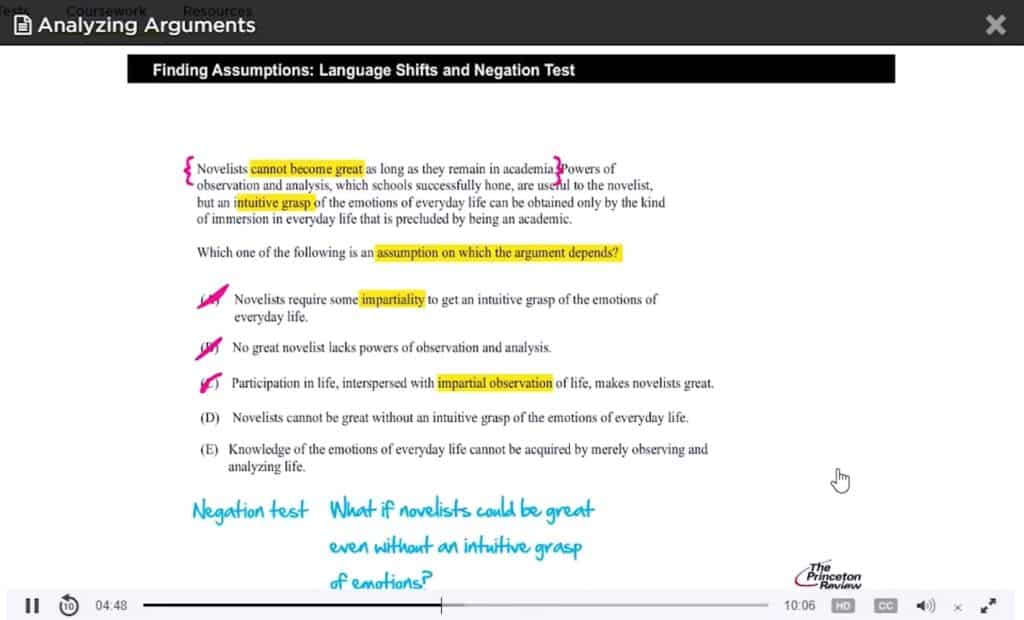
While the Fundamentals Course provides a structured 30-hour class schedule with guided homework assignments, their 170+ Score Guarantee Course expands this structure with intensive live sessions, practice tests, and targeted drills.
TheImmersion Bootcamp offers over 130 hours of live instruction, rigorous homework, and full-length proctored exams in a tightly scheduled format.
Verdict:
Blueprint emphasizes a modern, student-friendly approach to learning, with engaging video lessons and adaptive scheduling that allows students to target their weak points efficiently.
The video lessons focus on humor and animation, making them uniquely engaging for visual and independent learners, whereas the live classes are energetic and strategy-driven.
Two instructors lead each live class to give more immediate support, and students can repeat classes as needed.
Blueprint often updates for LSAT changes before official rollouts. These proactive updates ensure students use the most current resources, which is a significant advantage for an evolving test.
Princeton Review's methodology is more traditional, focusing on systematic content coverage, complete with extensive live instruction hours.
The curriculum follows a highly structured path through the LSAT’s core skills, reinforced by practice drills, strategic diagnostics, and an array of supplementary materials (eBooks and flashcards).
This program places emphasis on strategy-heavy live instruction with detailed homework – ideal for students who need structure, accountability, and in-depth class time.
Practice Materials
Both Blueprint and Princeton Review make use of official past LSAT questions licensed from LSAC, which is essential for realistic prep.
Blueprint provides access to 90+ full-length practice exams via LawHub Advantage, including live online proctored options.
The AI-powered Qbank, containing thousands of real LSAT questions, allows you to create custom practice sets and the software adapts the question difficulty to your strengths and weaknesses.
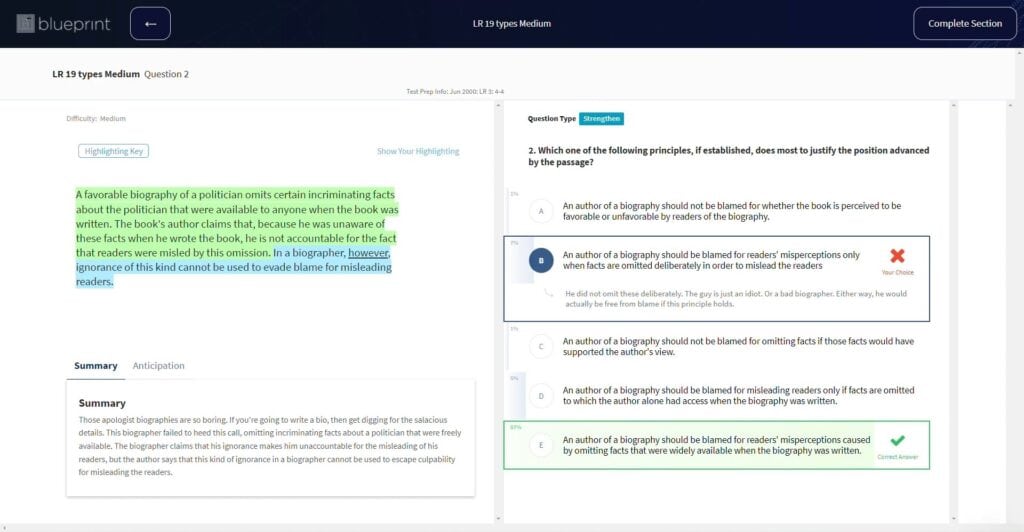
The adaptive practice with smart analytics really is a key offering whereby the program adapts to student progress, optimizing study efficiency.
Just as well, this platform offers gamified practice through points, streaks, and scoreboard features to keep competitive students motivated and engaged.
Blueprint is highly praised for its extensive, often animated video explanations for many of the practice questions, which make learning from mistakes easier. The video explanations are accompanied by comprehensive written breakdowns as well.
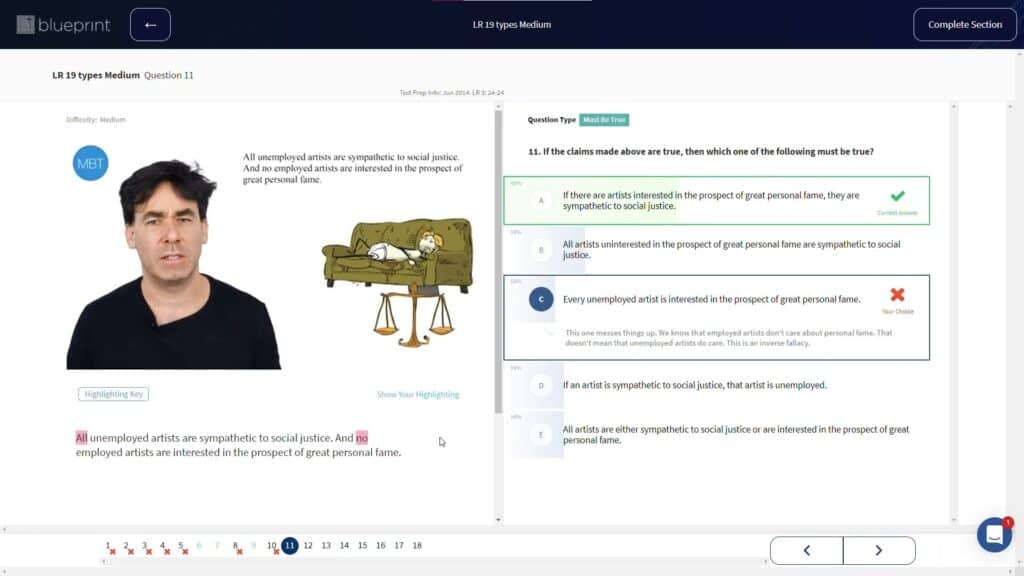
Princeton Review, an LSAC licensee, offers 90+ Official LSAT PrepTests through LawHub Advantage, including 6+ proctored exams as well.
Their practice library provides extensive skill drills and section tests designed to reinforce strategy and timing. A huge advantage is that this course gives learners access to all previously released LSAT questions.
Princeton Review also structures homework assignments around specific question types and pacing strategies, blending content mastery with exam simulation.
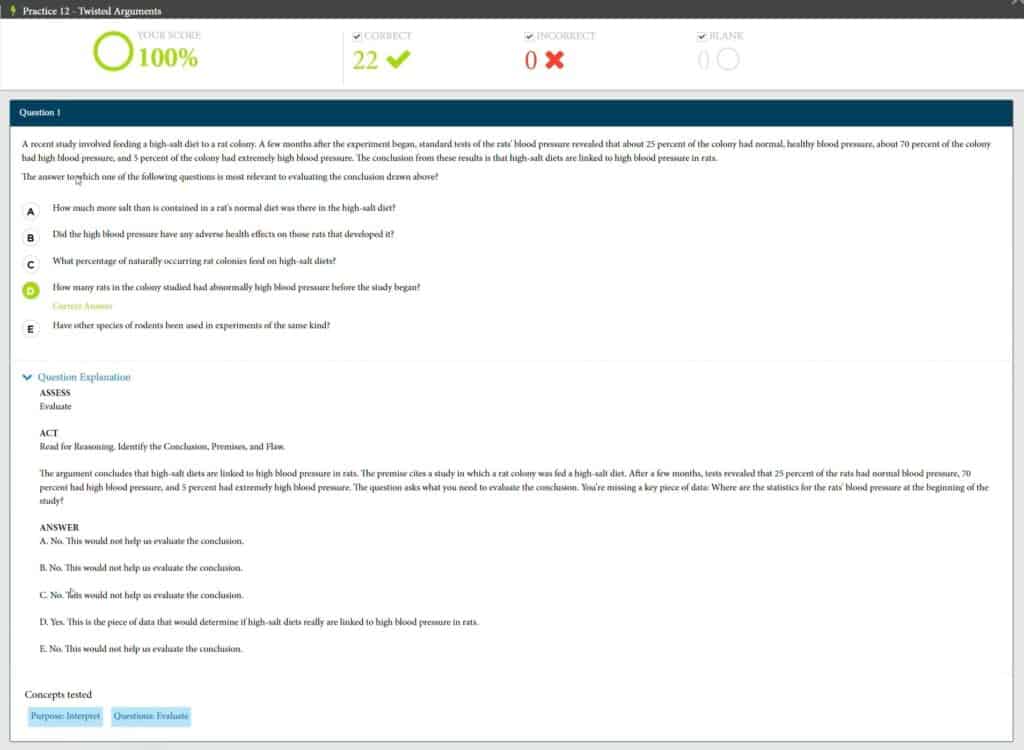
This program mostly provides detailed written explanations, with some video walkthroughs for complex problems.
Verdict:
While Blueprint uses adaptive Qbanks and gamification to keep studying personalized and fun; Princeton Review relies more on diagnostics and structured skill drills.
Another distinct difference is that LawHub Access is typically included in the base price for most Princeton Review courses, but Blueprint users often have to purchase it separately.
Overall, Blueprint is ideal if you want maximally engaging practice with deep video explanations and adaptive, gamified practice accompanied by tech-driven study tools.
Princeton Review fits students who value structured drills within a strategy-based curriculum, emphasizing proctored exams and homework.
Performance Analytics
Blueprint LSAT offers one of the most advanced analytics systems in the LSAT prep space.
Their platform offers in-depth analysis of student performance at multiple levels, including across entire practice exams, by section, question type, difficulty level, and even reasoning skill.
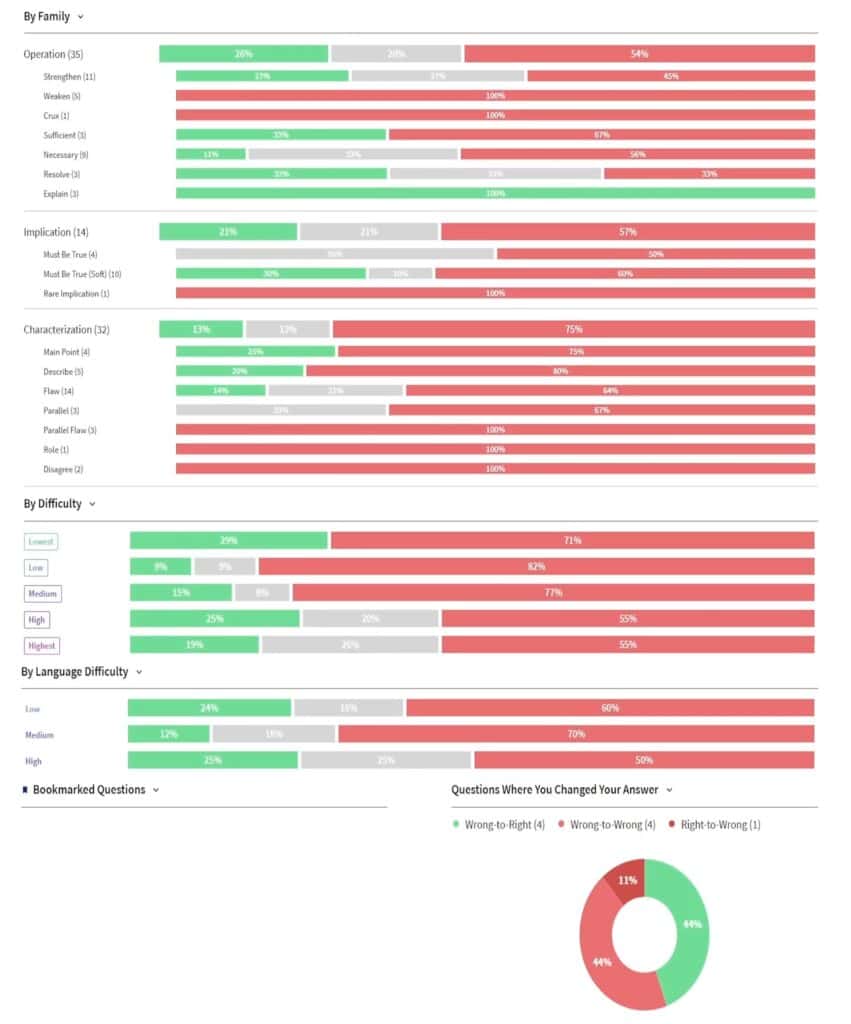
You’ll see real time metrics on accuracy, pacing, and trends over time, with visual dashboards that highlight your strongest and weakest areas. This helps students identify not only what they got wrong, but why, with patterns highlighted through intuitive data visualizations.
These insights are especially helpful for test-takers looking to fine-tune their strategies and target specific weaknesses efficiently.
Blueprint’s analytics are deeply integrated with its adaptive QBank, allowing for smart practice recommendations based on your past performance. The Qbank adapts as you progress, providing more challenging questions based on your performance trends.
The ‘Law School Compass’ is a unique tool within Blueprint LSAT that calculates your chances of admission to specific law schools based on your analytics. This aids in goal setting and targeted score improvement.
Princeton Review LSAT, while structured and strategy-oriented, provides more basic performance tracking.
Students can review their results by section and question type, and live instructors often provide feedback during review sessions.
The score reports after proctored exams show accuracy, timing, and trends, but the analytics are less dynamic compared to Blueprint.
Princeton Review’s approach is more instructor-guided, whereby analytics serve as supporting tools rather than personalized engines driving the learning experience. Most of their focus is on targeted feedback from instructors, and in-class strategic adjustments.
Verdict:
Blueprint provides a deeper, more actionable level of analysis by pinpointing the root cause of errors, while Princeton Review is less granular in its diagnostic capabilities.
Blueprint LSAT stands out for its advanced, AI-driven, real-time analytics that personalize your prep path by providing detailed insights, adaptive practice, and goal tracking.
The platform is particularly strong for data-driven learners who want actionable data visualizations and automated feedback to optimize their prep efficiency.
Princeton Review LSAT offers comprehensive analytics with progress reports and strategic guidance but relies more on instructor interactions and targeted feedback than raw data sorting.
The program is suitable for students who prefer structured feedback in a classroom-style format from live teachers, rather than frequent dashboard analysis.
Verdict: Which LSAT Prep Course is the Better Choice?
Blueprint is an ideal choice for students who want a tech-forward, visually engaging, and interactive LSAT prep experience.
The program stands out for its engaging animated video lessons, adaptive analytics, and modular structure, complete with adaptive study plans that evolve with your progress.
If you want detailed insights into whyyou make mistakes, the deep analytics are perfect for self-driven learners seeking personalized, data-driven prep, without needing instructor-led adjustments.
One final advantage here is the flexible subscription model. Blueprint provides a monthly payment option suitable for short-term prep schedules or students on a tight budget.
Princeton Review is an ideal choice for students who need a more structured, instructor-led LSAT prep experience.
With well-developed live classes, a ton of live instruction hours, clear pacing strategies, and strong score guarantees, Princeton Review is better suited for students who want accountability, traditional instruction, and live guidance with direct instructor access.
Their Immersion Bootcamp is unmatched in intensity – but it's also among the most expensive options on the market.
Overall, no single prep course is universally "better". The decision hinges on your learning preferences, schedule flexibility, budget, and score goals. Consider which platform's philosophy aligns best with how you learn and what you need to succeed.
Blueprint excels with its innovative, highly engaging, and personalized approach, leveraging advanced technology to pinpoint and address weaknesses. It's ideal for modern learners aiming for elite scores.
Princeton Review provides a comprehensive and traditional curriculum. Its strengths lie in extensive official LSAT content, and a strong focus on community. It's a dependable choice for those who prefer a conventional yet thorough approach.
Blueprint Vs. Princeton Review LSAT FAQs
Which Is Better: Blueprint Or Princeton Review LSAT?
Blueprint LSAT is better for visual learners, self-starters, and students seeking flexible study options.
It excels with its tech-savvy, animated, adaptive learning platform, and monthly self-paced plans starting at $99. The program is ideal if you want control over your prep and prefer a modern, interactive tech-driven platform.
Princeton Review LSAT is better for students who want a structured, classroom-like experience with instructor-led guidance.
Its 170+ score guarantee course and immersive bootcamp are designed for those who benefit from scheduled classes, intensive homework, and strategy-focused instruction.
Which LSAT Course Is More Affordable?
Blueprint uses a monthly subscription model for self-paced courses with discounts for bundles, which can be flexible but pricier over long study periods.
Princeton Review charges a flat fee for their self-paced course, which might be more economical if you study longer.
Live course prices are comparable, though Princeton Review offers a wider variety of live instruction hours.
Tutoring at Blueprint tends to be more expensive but bundled with comprehensive course access, while Princeton Review offers lower hourly rates.
LawHub Advantage, required for official materials, is usually included in Princeton Review’s price but often separate for Blueprint.
Can I Switch Between Self-Paced And Live Courses With Either Provider?
With Blueprint LSAT, yes – you can switch or upgrade from the self-paced plan to a live course fairly easily.
If you start with the monthly self-paced option and later decide you want live instruction, Blueprint allows you to apply what you’ve already paid toward a live course (depending on timing and promotions). The platform is also fully integrated, so switching doesn’t disrupt your progress or saved analytics.
With Princeton Review LSAT, switching between formats is less flexible.
Their self-paced and live courses are treated as separate products, so moving between them usually requires purchasing a new course or paying a fee. Some exceptions may apply, but it’s not a built-in feature the way it is with Blueprint.
Ultimately, Choose Blueprint if you want the option to start self-paced and switch to live classes later. Princeton Review is better if you’re confident in your preferred format from the beginning.
Which LSAT Course Is More Effective For Students With Tight Schedules Or Full-Time Jobs?
Blueprint LSAT is generally more effective for busy students balancing work or other commitments.
Its self-paced monthly plans allow you to study anytime, with short, modular video lessons and practice sets that can be completed in flexible chunks. You can also switch between self-paced and live sessions if needed, and the mobile-friendly platform makes it easy to squeeze in practice on the go.
Princeton Review offers a more rigid schedule requiring heavier time commitment. While effective, it may be harder to keep up if your availability is inconsistent.
Which LSAT Course Is Better For Students Aiming For Top Law Schools?
Blueprint’s 170+ Score Guarantee LSAT Course is specifically designed for ambitious students aiming for elite LSAT scores, offering advanced strategies, 60 hours of live instruction, and adaptive analytics that target your weakest areas.
The course structure allows high achievers to move quickly through foundational content and zero in on high-impact skills.
Princeton Review’s 170+ Score Guarantee LSAT Course is also strong, with a solid reputation and intensive instruction.
However, it’s slightly more structured and may suit students who need pacing and guidance more than independent customization.
Ultimately, choose Blueprint if you’re a driven, self-motivated student aiming for a 170+ score and want flexibility with targeted tools or go for Princeton Review if you want hands-on support and a proven pathway to a 170+ score with a traditional classroom feel.
We may earn commissions from some links on this page, but this does not affect our reviews or your experience.
Our Verdict
Blueprint wins for most students with its modern platform, adaptive learning, and engaging content. Princeton Review is better if you prefer traditional classroom-style instruction.
Learn more about Blueprint
Read our full review →
Learn more about Princeton Review
Read our full review →