


Princeton Review LSAT Review
by Princeton Review
The Princeton Review LSAT courses are popular among aspiring law students
✓Pros
- ✓8,000+ practice questions with many sourced from official LSAC exams
- ✓Up to 144 hours of live instruction with Immersion 165+ course
- ✓Access to 75+ official LSAT PrepTests via LawHub Advantage
- ✓165+ score guarantee for qualifying courses with refund option
✗Cons
- ✗A heavy course load that some students struggle to complete.
Highlights
- ✓Platform: Online / Online & In-Person / Online & In-Person / Online
- ✓Price: $799 / $1,099 / $2,099 / $3,999
- ✓Days Access: Not Specified / 365 days / 365 days / 365 days
- ✓LSAT Practice Questions: 8,000+ / - / 8,000+ / 8,000+
- ✓Live Instruction: None / 30 Hours / 84 Hours / 144 Hours
- ✓Recorded Video Lessons: 150+ Hours. / 35+ Hours / 35+ Hours / 35+ Hours
Price
$799 - $5,000
What Students Are Saying
Sign in to leave a review

The Princeton Review LSAT courses are popular among aspiring law students.
However, given the hefty price tags, it’s understandable that you would want to know this: what makes their review programs better than others out there?
This Princeton Review LSAT Course review will address that question, providing insights into why thousands of students found this LSAT course valuable to their law student journey.
Summary Table
| Self-Paced | Fundamentals | LSAT 170+ | Immersion 170+ | |
|---|---|---|---|---|
| Platform | Online | LiveOnline (in-person varies by location) | LiveOnline (in-person varies by location) | Online |
| Price* | $799 | $1,249 | $2,099 | $3,999 |
| Days Access | 365 days | 365 days | 365 days | 365 days |
| Official PrepTests (LawHub) | 90+ | 90+ | 90+ | 90+ |
| Live Instruction | None | 30 Hours | 65 Hours | 130 Hours + workshops |
| Recorded Video Lessons | 150+ Hours | Included | Included | 150+ Hours |
| Online drills and instruction | Yes | Yes | Yes | Yes |
| Access to LawHub Advantage | Yes | Yes | Yes | Yes |
| The Princeton Review Guarantee | Yes | Yes | Yes | Yes |
| LSAT 170+ Score Guarantee | No | No | Yes | Yes |
* Prices can vary by schedule/location and promotions.
Princeton Review LSAT Course Overview
The exact types and amount of material you can access through your Princeton Review LSAT course depends on the plan you paid for. However, here is a general overview of what you can get:
- Up to 365 days of access to study materials, questions, and exams
- Access to previously released LSAT questions through Princeton Review materials and LawHub
- Up to 130 hours of live instruction, plus additional workshops in Immersion
- Up to 150 hours of recorded video lessons
- Online drills, explanations, and performance tracking tools
- One year access to LawHub Advantage, which is valued at $115 and includes 90+ Official LSAT PrepTestsTM
- Princeton Review Guarantee for Self-Paced and Fundamentals Courses, which entitles students to a refund (if they don't get a higher LSAT score on the actual exam) or a repeat of the course (if they are not satisfied)
- LSAT 170+ Score Guarantee for LSAT 170+ and Immersion 170+ courses, which can qualify students for a refund if their score does not improve by at least 10 points (when starting below 160) or does not reach at least 170 (when starting at 160+), subject to full guarantee terms
Princeton Review LSAT Course Review for 2026
In this section, you'll learn more about the quality of Princeton Review LSAT courses as we tackle several aspects of the course experience:
Free Trial
Signing up for a Princeton Review account is easy and free.
However, even if you make a free account, you'll quickly realize it doesn't do much. Princeton Review does not offer a free trial for any LSAT prep courses. Instead, it provides free resources such as a practice test and strategy sessions/events.
Moreover, those free offers do not provide an experience sufficient to assess if purchasing an LSAT course is best for them. For instance, I took the free practice test, and the interface could have been better.
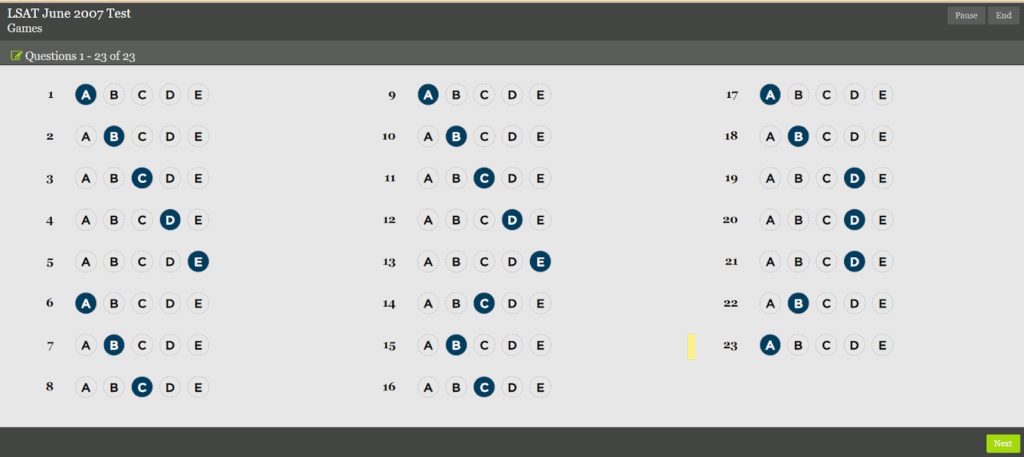
When I started, the screen only showed an answer sheet. The questions aren't shown as they are in a separate PDF booklet provided before the test. There is also no timer, although each section is supposed to be timed.
User Interface & Experience
Once you buy a course, you can access it through your Princeton Review dashboard. You can find that on your account.
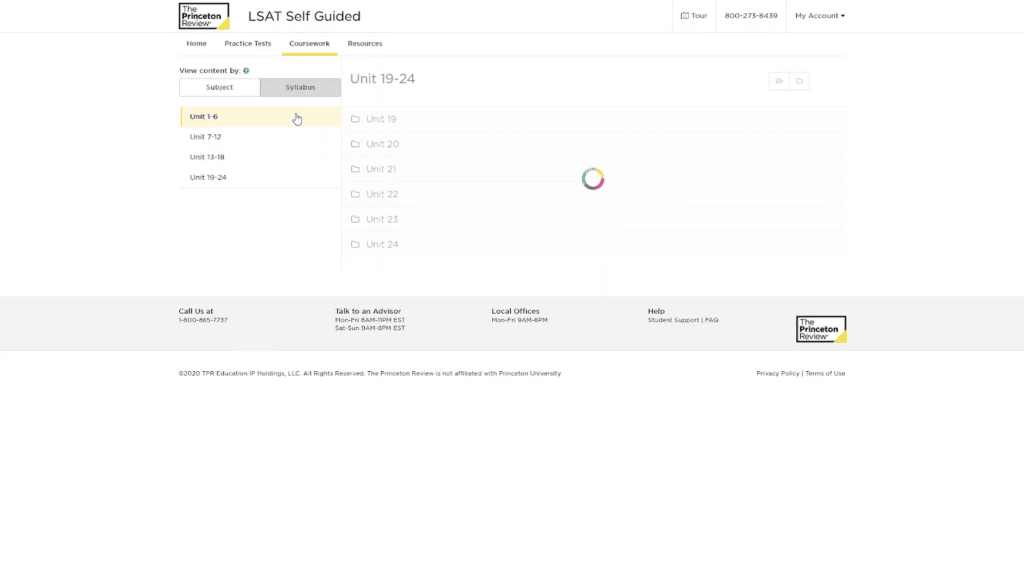
There are mixed sentiments regarding the Princeton Review user interface for their LSAT courses. Some say it's too simple, with nothing special besides having the option between a Subject or Syllabus view. Some even find it quite archaic.
Meanwhile, others appreciate how utilitarian and straightforward it is. Everything is easy to find and access, which makes it more efficient for students to review.
However, I agree that Princeton Review still has room to improve its user interface so it's more user-friendly.
Courses/Products
Princeton Review allows you to choose from four LSAT courses:
- Self-Paced
- LSAT 170+
- Immersion 170+
- Fundamentals
Self-paced, as the name implies, is designed so you can complete it according to your schedule or liking. There are no live classes or instructors. Instead, you watch the recorded videos, read the resources, and answer questions at a time most convenient to you.
Meanwhile, the LSAT 170+ and Immersion 170+ courses are designed around Princeton Review’s 170-point target and its related score guarantee terms.
A score of 170 is relatively high, as the highest achievable score on LSAT is 180. Thus, the 170+ courses have more material than the other two offerings. Moreover, their type of guarantee is different.
The Fundamentals review course is a blend of online resources and live instruction. It is generally less demanding than the 170+ tracks.
Having a variety of courses is an excellent initiative from Princeton Review because it allows students to choose one that best suits their lifestyle. After all, not all aspiring students are the same.
For instance, some have hectic and inflexible work schedules, and they can benefit from the flexibility of Self-paced or Fundamentals courses.
Meanwhile, other students need help staying committed to the review, so they would prefer a program that requires them to attend live classes like those included in the Princeton Review’s 170+ and Fundamentals courses.
Curriculum
Princeton Review’s curriculum is split into 24 units each containing 1-4 lessons. These are the subjects it covers:
- Arguments
- Reading Comprehension
- Global Strategies
These subjects align with the current LSAT format, which now emphasizes Logical Reasoning and Reading Comprehension:
- Reading Comprehension
- Logical Reasoning
Meanwhile, the last subject of the Princeton Review LSAT review – Global Strategies – is dedicated to strategies and tips to help students take the LSAT more efficiently.
Princeton Review’s volume of material and resources allows it to cover its curriculum comprehensively. While that sounds great, some students would remark that it’s too comprehensive, as they find the amount of materials and resources to be excessive.
Instructors
Students who purchased the Fundamentals or 170+ courses interact the most with instructors as they have live classes. Their experiences were varied.
Students shared that they had instructors who were keen on sharing strategies to answer the test.
They were able to study under well-rounded instructors, who were even past LSAT takers and were able to get stellar scores. A chance to learn from them is great as students do not just receive expert knowledge but also real-life-based tips.
Meanwhile, Self-Paced students have minimal to almost zero instructor interaction. They only learn through recorded videos, which do not even feature the instructors’ faces. This left some feeling like they do not have a connection with the people who are supposed to guide them through their review.
Practice Questions
Princeton Review LSAT review students get extensive practice material, including previously released LSAT questions and official LSAC PrepTests through LawHub Advantage.
That last part is notable because if students are able to answer official LSAT questions, they become more familiar and confident with the exam.
Practice Tests
The amount of practice tests Princeton Review offers is also impressive.
All courses have access to 90+ LSAT PrepTestsTM through LawHub Advantage, which are full-length practice tests prepared by LSAC and can be taken online any time the student wants.
The LSAC prepares the LSAT. Therefore, like with the practice questions, students become familiar with the LSAT as they answer tests that the actual exam creators prepared.
Another thing students look forward to with the Princeton Review LSAT courses is the proctored practice exams, which simulate the actual LSAT exam.
Pricing
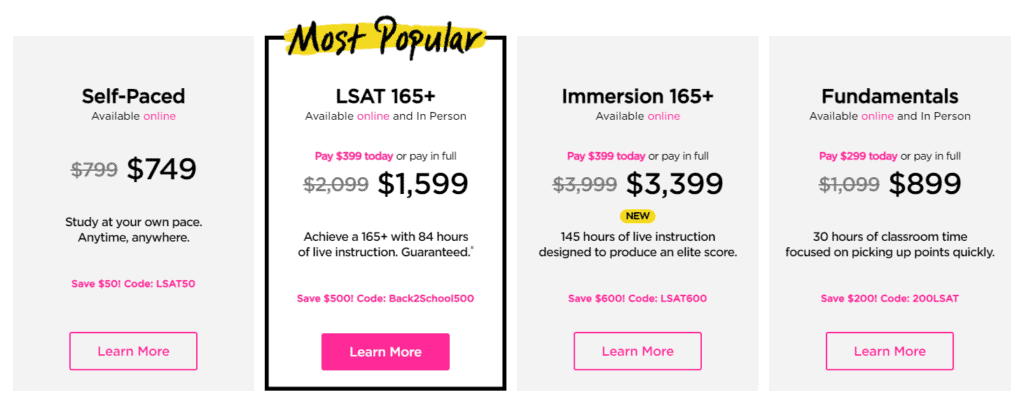
With the Immersion 170+ course going as high as $3,999 when undiscounted, it is clear that Princeton Review LSAT courses are more of an investment than a budget-friendly option. Indeed, many students express that the price is one of the course's most significant drawbacks.
Thus, the big question is – is the price worth it, especially for the more expensive courses (i.e., LSAT 170+ and Immersion 170+)? The responses are often mixed.
Reasons Students Find the Pricing Worth It
Some students find the hefty price tag worth it because of the volume of materials and overall quality of the resources, especially with many of the being sourced from the LSAC. The availability and expertise of the instructors also added value.
A few individuals also stated that they were willing to pay the price because Princeton Review helped keep them committed to the study schedule and live classes. They credit the course for significant differences in their starting and actual LSAT scores.
Another reason students find the high price worth it is because of the guarantees. They are assured that they can receive a refund or free course retake if they are not satisfied or do not get an LSAT score increase. Moreover, the guarantees show Princeton Review’s confidence in the quality of its materials and instructors.
Reasons Students Do Not Find the Pricing Worth It
However, other students still find the prices just exorbitant even with all those offerings. They state that it's nearly impossible to go through the sheer number of materials and tests; thus, they couldn't maximize the value of their payment.
Moreover, they do not find the guarantees to be assuring enough. That’s because the conditions to receive a refund or course retake are stringent, so even if they didn’t get a score increase or were not satisfied with the course, they do not automatically get back their money.
Another disappointment to students was when they noticed inconsistencies in the quality of materials.
For instance, they identified mismatched questions and answers, grammatical errors, misspellings, blank drills, and digital bugs. Some also experienced a lack of response from their instructors or tutors.
The pricing issue also becomes more significant when students compare Princeton Review to other LSAT prep companies that offer LSAT reviews.
Many students lament that they tried both Princeton Review and budget-friendly programs – like 7Sage – and found the latter to deliver similar, if not better, results.
Community and Support
In terms of community support, Princeton Review does not offer much. There is no student forum, and there also seems to be no Facebook group. However, there are live classes, and students may interact during those times.
However, the company did make up for that lack of community with its instructors and tutors. Many students state that their instructors were enthusiastic and approachable. Therefore, getting a timely and useful reply to your queries and questions should not be an issue.
Those who want a more 1-on-1 approach may also opt for private tutoring. However, that is an additional expense, as none of the courses include private tutoring sessions.
If you're interested in private tutoring, it starts around $167 per hour depending on the package. For example, current LiveOnline tutoring packages include 10 hours for $1,800 ($180/hr) and 30 hours for $5,000 ($167/hr).
Princeton Review LSAT Course Pros and Cons
PROS
-
Comprehensive coverage achieved by an efficient curriculum and a high volume of materials and resources.
-
Live classes handled by expert instructors, some of whom have taken the LSAT themselves and earned high scores.
-
Helps students stay committed to the review by providing a study schedule and live classes they wouldn’t want to miss.
-
Refund or retake course guarantees that assure students of Princeton Review’s confidence in their courses.
CONS
- A heavy course load that some students struggle to complete.
Verdict
The Princeton Review LSAT courses are beneficial to students who are aiming for an increase in their LSAT scores.
The high quality and volume of materials and resources allow them to build subject knowledge while instructors provide them with tips and strategies to efficiently take the LSAT.
Also, Princeton Review advertises refund and/or course-repeat guarantees, but eligibility depends on each program’s specific terms and completion requirements.
You can check out the other reviews we did on other LSAT prep courses below:
- Kaplan LSAT Review
- Blueprint LSAT Review
- 7Sage LSAT Prep Review
- LSAT Demon Review
- Princeton Review LSAT
- LSAT Demon vs 7Sage
Princeton Review LSAT Course FAQs
Is the Princeton Review LSAT Course Worth It?
Many say that the Princeton Review LSAT courses are not worth it because there are cheaper competitors, and they cannot maximize the volume of study materials.
However, some still find the courses worth it because they were willing to commit to them and go through the numerous resources. Individuals who have done so were able to see a significant difference in their diagnostic LSAT scores and actual LSAT scores.
How Much Does the Princeton Review LSAT Course Cost?
A Princeton Review LSAT course can cost between about $799 and $3,999 at standard pricing.
The most affordable option is typically the Self-Paced course at $799, while the most expensive option is the Immersion 170+ course at $3,999. Live-course pricing and discounts can vary by schedule and promotion.
What's Better: Kaplan or Princeton Review LSAT?
Kaplan and Princeton Review offer LSAT review courses that are similar in price and volume of materials.
While each company has its edge, some say the Princeton Review LSAT courses are better than Kaplan's because of the 170+ score guarantee.
Moreover, Princeton Review's questions and material are more official as they are based on past LSAT exams and those newly released by the LSAC.
We may earn commissions from some links on this page, but this does not affect our reviews or your experience.