


The highest LSAT score is 180, the top of LSAC's 120 to 180 scale. In the current reporting window a 180 accounts for 0.15% of all test scores, which works out to roughly 1 in 670.
That is rarer than the figure you usually see quoted, and the score just below it is rarer still.
- The highest possible LSAT score is 180. The scale runs 120 to 180 and nothing sits above it.
- About 0.15% of test scores are 180s, roughly 1 in 670, using LSAC's 2023-2026 percentile table.
- A 179 is actually rarer than a 180: 0.11% of scores against 0.15%.
- There is no universal raw-to-scaled chart. LSAC equates every form, so the number of questions a 180 takes moves from test to test.
- You almost certainly do not need one. A 170 already sits above 94% of test scores.
What the highest LSAT score actually is
Your LSAT result starts as a raw score, which is just the number of questions you answered correctly. According to LSAC's official scoring page, every question is weighted exactly the same, and there is no deduction for a wrong answer. Which questions you get right does not matter, only how many.
That raw score is then converted onto the 120 to 180 scale that appears on your score report. LSAC runs this conversion so that scores earned on different administrations mean the same thing, because no two forms are exactly equal in difficulty. A 180 is the highest possible score on that scale and a 120 is the lowest.
Two things follow from this, and most pages about the top score skip both. There is no such thing as a 181, no matter how well you do. And because the conversion is recalculated for every form, the raw score that earns a 180 is not fixed. For the mechanics of the scale itself, including how the bands behave lower down, see our guide to the LSAT score range.
How rare is a 180?
LSAC publishes a percentile table showing, for each score, the percentage of test scores that fall below it. The current table covers the 2023-2024, 2024-2025 and 2025-2026 testing years.
That table tells you what share of scores are below a 180. It does not directly tell you how many people actually earn one. To get that, you subtract each row from the one above it, and for the 180 itself you subtract from 100. Here is the top of the scale worked out:
| Score | Percent below (LSAC) | Share of scores at exactly this score | Roughly |
|---|---|---|---|
| 180 | 99.85% | 0.15% | 1 in 670 |
| 179 | 99.74% | 0.11% | 1 in 910 |
| 178 | 99.57% | 0.17% | 1 in 590 |
| 177 | 99.34% | 0.23% | 1 in 435 |
| 176 | 99.08% | 0.26% | 1 in 385 |
| 175 | 98.72% | 0.36% | 1 in 278 |
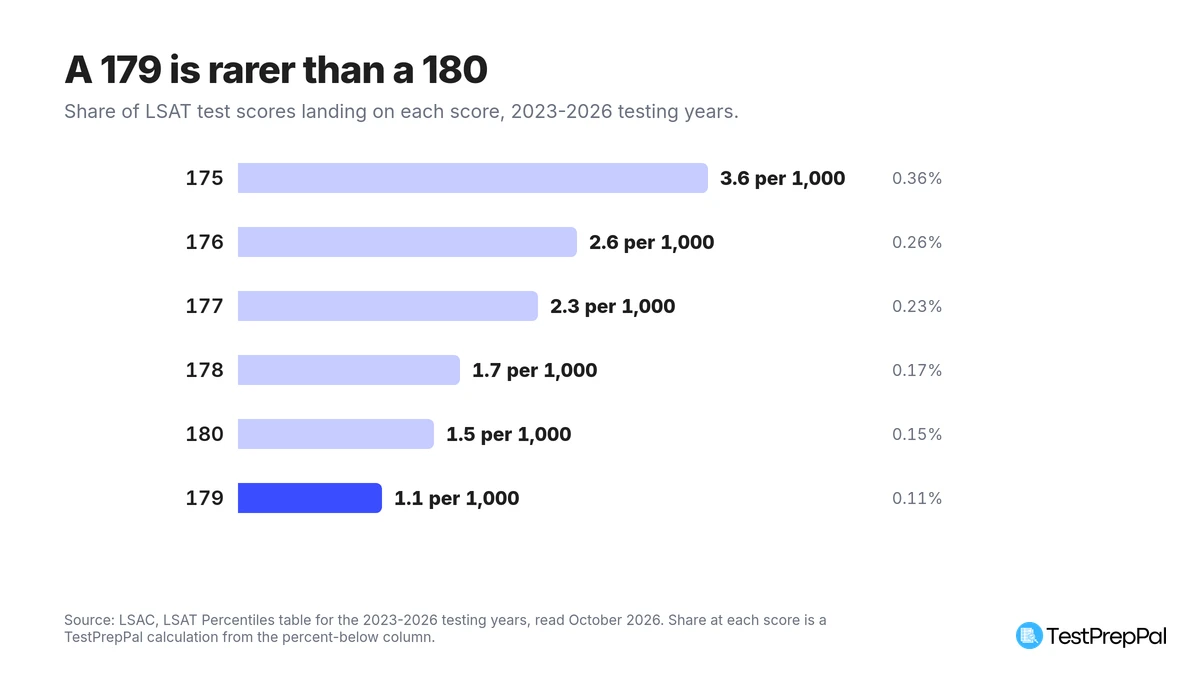 Share of LSAT test scores at each top score, 2023-2026 testing years. Source: LSAC percentile table, with the per-score share calculated by TestPrepPal.
You will often read that a 180 is about 1 in 1,000. LSAC's own numbers put it closer to 1 in 670, so the top score is meaningfully more common than that shorthand suggests. It is still rare: scores of 175 or higher make up 1.28% of the pool, about 1 in 78, and the full percentile picture is in our LSAT score percentiles breakdown.
Why a 179 is rarer than a 180
Look at the table again. A 179 is earned by 0.11% of test scores and a 180 by 0.15%. The perfect score is more common than the one below it.
This is not a reporting error. It is what happens at the edge of any capped scale. Every score below the top sits in a narrow band with another score above it, so it only collects the people who land in that band. The 180 has no band above it, so it absorbs everyone who reaches the top raw cut and everyone who would have scored higher if the scale allowed it.
In practice, that means the gap between a 179 and a 180 is thinner than the numbers suggest. If you are testing at that level, you are not chasing a rare outcome so much as hoping the form you sit treats your last missed question kindly.
How many questions can you miss and still score 180?
The honest answer is that nobody can give you a fixed number, and any page that does is guessing. LSAC equates each form separately, so the raw cut for a 180 moves between tests.
What we can give you is an estimate. Our LSAT score converter models the raw-to-scaled relationship across three curve settings. Here is what the typical setting produces at the top of the scale, on a 75-question scored count:
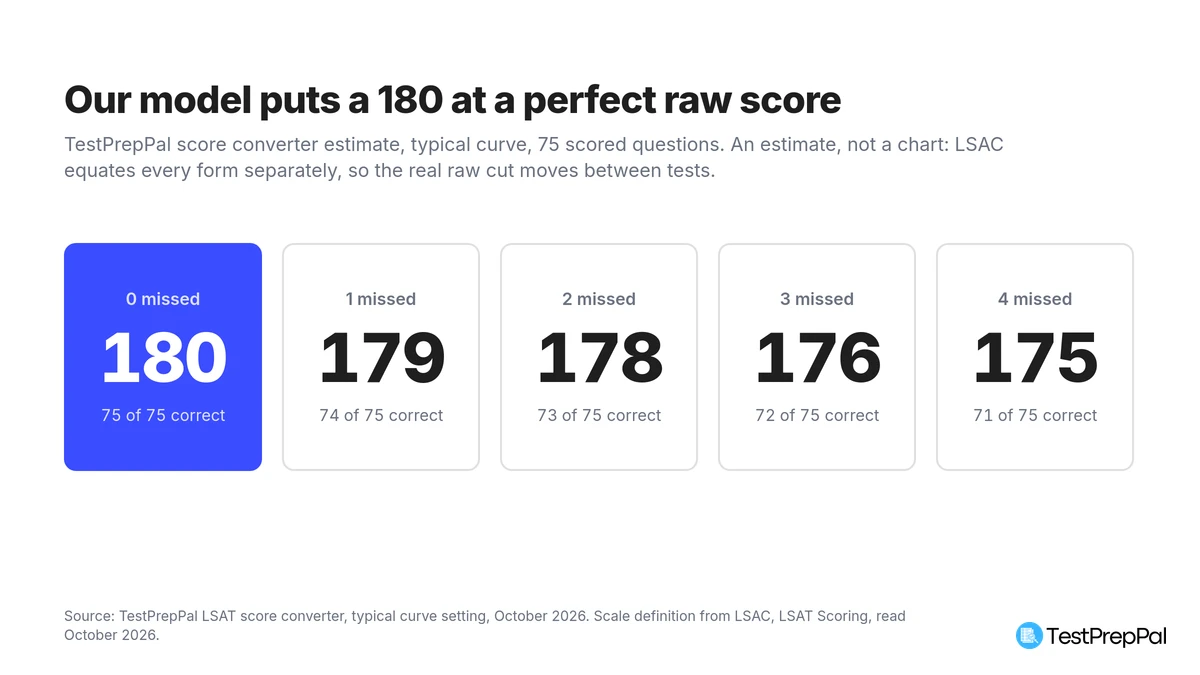 Estimated scaled scores at the top of the raw range, TestPrepPal score converter, typical curve setting.
Across all three curve settings, our model puts a 180 at a perfect raw score, and the first missed question drops you to a 179 or a 178. Treat that as a planning assumption, not a promise. On a real administration the cut can be slightly kinder, and on a harder form it can be exactly that strict.
The practical takeaway is the one that survives the uncertainty: at this level there is no margin to spend. A student aiming for a 175 can absorb a handful of misses across the test. A student aiming for a 180 cannot plan around any. If you want to see how your own practice results convert, the official disclosed PrepTests come with real conversion tables for the forms they cover, which beats any estimate including ours.
Does a 180 come with a margin of error?
Yes, and this is the part almost nobody mentions. LSAC reports every score to law schools alongside a score band, because a single test result is an imperfect estimate of the skills being measured.
The band comes from the standard error of measurement. As LSAC explains it, your true proficiency is unlikely to sit more than a few points above or below the score you received. A 180 is still a 180 on your report, but LSAC itself frames it as an estimate rather than a verdict.
The scale stops at 180, but your measured ability does not. That is why a 178 and a 180 are much closer in what they actually tell an admissions reader than the "perfect score" framing implies.
Do you need a 180?
No. Almost nobody does, and building a study plan around the ceiling is usually a mistake.
LSAC's table shows that a 170 already sits above 94.48% of test scores, which puts every score from 170 up inside the top 6% of the pool. Chasing the points beyond that has a real cost in months of study and in retake fees, and they are the hardest points on the whole scale to win.
A better question is what score actually opens the doors you care about. Our guide to what counts as a good LSAT score works through that against school medians, and how hard the LSAT is sets expectations on what a realistic jump from your diagnostic looks like.
If you are already scoring in the 170s and want the last points, the limiting factor is usually timing and accuracy under pressure rather than content gaps. That is the situation where structured review earns its price, and the options are compared in our LSAT prep course reviews. Everything else we publish for the test sits on the LSAT hub.
Highest LSAT score FAQs
How rare is a 179 on the LSAT?
A 179 is earned by about 0.11% of test scores, which is roughly 1 in 910. That makes it rarer than a 180, which 0.15% of scores reach. The reason is structural: 180 is the top of the scale, so it collects everyone at or above the highest raw cut, while 179 is a single narrow band with a score above it.
Who got the highest LSAT score ever?
The highest score anyone can get is 180, and it is not a record any one person holds. About 0.15% of test scores reach it in each reporting window, so plenty of people earn one every year, and there is no score above it to break. LSAC does not publish individual test taker scores or maintain any all-time list, so claims naming a specific person as the all-time high scorer cannot be checked against official data.
How rare is a 177 on the LSAT?
About 0.23% of test scores are 177s, or roughly 1 in 435. Cumulatively, 0.66% of scores are 177 or higher. A 177 sits above 99.34% of test scores in LSAC's current table, which puts it comfortably inside the top 1%.
Is a 148 a bad LSAT score?
A 148 is below the middle of the pool: LSAC's table shows 30.07% of test scores fall below it, so about 70% match or beat it. Whether that is a problem depends entirely on where you are applying, since school medians vary widely. Our good LSAT score guide maps score ranges to the schools they realistically reach.
We may earn commissions from some links on this page, but this does not affect our reviews or your experience.