

INBDE study plan generator
The start date defaults to today. Use your scheduled test date, or a target date if you have not booked your Prometric appointment yet.
Be honest here. Underestimating hours is better than writing a fantasy schedule.
This sets the rhythm of the plan and the size of your long readiness block.
No plan generated yet
Set your dates and study load above, then click Generate Plan.
Our recommended INBDE prep resource:
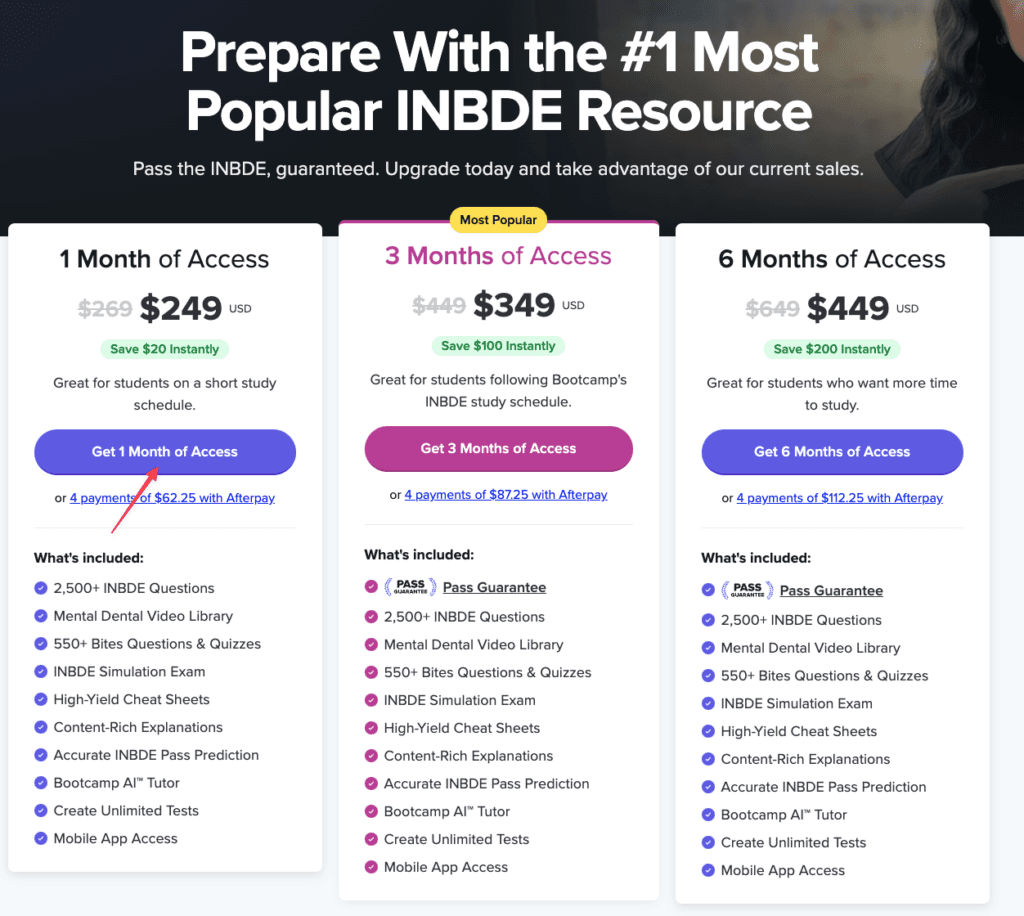
INBDE Bootcamp
A structured, all-in-one INBDE prep course with comprehensive materials.
See latest INBDE Bootcamp dealsWhat This INBDE Study Plan Tool Does
This tool is designed to answer a harder question than a generic “8-week INBDE schedule” article:
What should my actual plan look like given my timeline and my weekly hours?
The output is built around four things:
- your start date and exam date
- your available hours per week
- your study-day count
- a repeatable weekly rhythm built around daily case-based questions
Instead of pretending every schedule is equally realistic, the generator assigns a readiness label:
- Balanced
- Tight
- Stretch
- High Risk
That matters because a good INBDE study-plan tool should not hand out false confidence when the timeline is clearly too compressed — or too stretched out to keep your integrated reasoning sharp.
How to Use This INBDE Study Plan Generator
The simplest way to use this tool is:
- set your start date and exam date
- choose a weekly hour target you can actually sustain
- choose how many days per week you can realistically study
Then click Generate Plan. The page will build a structured timeline, show your phase breakdown, and generate a week-by-week schedule you can actually follow.
Most candidates do not need another generic “study harder” schedule. They need a plan that reflects their actual calendar and their weakest content lanes.
Why We Built It Around the INBDE, Not a Generic Exam
The INBDE is not a scored admissions test. It is the pass/fail dental licensure board exam, delivered at Prometric over roughly 1.5 days (Day 1 + Day 2) with about 500 items. It is deliberately clinically integrated and case-based — much of the exam is presented as Dental Clinical Content (DTC) patient cases rather than isolated recall.
That changes what a good plan looks like:
- there is no target “score,” so the plan tracks readiness, not points
- case-based question practice with rationale review matters more than passive rereading
- content is organized by a matrix of Foundation Knowledge (FK) and Clinical Content (CC) areas
- integrated clinical reasoning deserves dedicated practice, not an afterthought
- progress is measured with readiness assessments, not timed “full-lengths”
This generator is built around those realities instead of copying a schedule from a scored exam.
What Makes The Output Useful
The generator does not just assign random daily tasks. It uses a fixed five-phase structure:
- Diagnostic + Setup
- Content Review + Daily Qbank
- Applied Qbank + Clinical Reasoning
- Readiness Assessment Phase
- Taper + Test-Day Readiness
Within that structure, the tool:
- builds a repeatable weekly rhythm around your available time
- keeps a daily case-based question habit from week one, not just at the end
- rotates review through grouped FK × CC content lanes
- ramps up DTC patient cases and integrated reasoning in the back half
- schedules readiness assessments as you approach test day
- preserves recovery blocks so the schedule is still usable in real life
How The Generator Builds Your INBDE Plan
The tool uses a five-phase structure because strong INBDE schedules usually follow the same arc:
| Phase | Main purpose | What should happen here |
|---|---|---|
| Diagnostic + Setup | establish a baseline and lock the calendar | baseline Qbank assessment, resource choice, error-log setup |
| Content Review + Daily Qbank | rebuild weak content without dropping questions | FK × CC lane review, daily questions, pharmacology practice |
| Applied Qbank + Clinical Reasoning | shift into timed, mixed practice | timed Qbank blocks, DTC patient cases, rationale review |
| Readiness Assessment Phase | simulate the exam and measure readiness | readiness self-assessments, deep review, targeted repair |
| Taper + Test-Day Readiness | reduce noise and protect performance | high-yield review, Prometric logistics, rest |
That phase model is more useful than a flat content checklist because INBDE prep changes over time. The work you should do eight weeks out is not the work you should do three days out.
How to Interpret the Readiness Label
The generator gives each plan a readiness label on purpose:
- Balanced means the timeline and workload look reasonable if you actually stick to them.
- Tight means the plan can work, but missed weeks or weak rationale review will hurt quickly.
- Stretch means the schedule is aggressive and should focus heavily on high-yield questions.
- High Risk means the plan is likely too compressed unless something changes.
That label is not there for decoration. It is one of the most important parts of the page.
Candidates often build unrealistic INBDE schedules because they overestimate weekly study time, lean too hard on passive content review, or delay real case-based practice. In practice, the strongest predictor of readiness is consistent, reviewed question volume — not how many chapters you reread.
How to Choose Your Inputs
If you are not sure what to enter, use these rules:
Weekly Hours
- 15-20 hours/week is common for candidates studying around clinic and coursework.
- 20-28 hours/week is common for a serious, focused dedicated study block.
- 30+ hours/week usually means a compressed or more full-time style of prep.
Study Days Per Week
- 3-4 days/week works best when one day is a long protected block.
- 5-6 days/week works best for most candidates because it keeps daily question momentum.
- 7 days/week is usually only useful if one of those days is intentionally light.
Why the Weekly Cards Include Resources
A study plan without linked resources creates another problem: candidates know what to do, but not where to do it.
That is why each week in this tool can include relevant Test Prep Pal pages such as:
- question-bank and practice-test roundups
- content-review books and flashcards
- cheat sheets for drugs, anatomy, and management rules
- mobile apps for questions on the go
- the INBDE exam guide for test structure and logistics
The goal is for each week to feel actionable, not abstract.
Common Reasons INBDE Study Plans Fail
Most broken schedules do not fail because the candidate lacked motivation. They fail because the plan itself was weak.
Common problems include:
- too much passive reading and not enough reviewed questions
- skipping rationales and only checking whether the answer was right
- treating DTC patient cases and integrated reasoning as optional
- ignoring pharmacology and dosing until the final week
- waiting too long to take a readiness assessment
- building a plan around ideal weeks instead of real weeks
The best schedules are structured, but they also adapt when your readiness data says something needs to change.
When This Tool Is Most Useful
This type of generator is strongest for:
- students deciding between a 6, 8, or 10 week plan
- candidates balancing INBDE prep with clinic, coursework, or a rotation
- repeat testers who need a cleaner reset around questions, weak lanes, and readiness discipline
- anyone who wants a structured plan without building one manually in Sheets or Notion
When You Should Probably Change the Plan
You should consider regenerating or revising your schedule if:
- your first 1-2 weeks already feel unsustainable
- you are consistently missing your planned study blocks
- your readiness assessments keep flagging the same weak lanes
- your question accuracy is not improving despite daily practice
- your test date is close and your readiness still does not match the plan
A good generator should make it easier to adapt your schedule, not lock you into a bad one.
Related INBDE Resources
Use these pages alongside the generator:
- INBDE Exam Guide for the test structure, DTC case format, and logistics
- INBDE Score Calculator to see how the 49-99 scale and the 75 passing line work
- INBDE Question Banks to choose your primary Qbank and readiness assessments
- INBDE Practice Tests for realistic readiness context as test day approaches
- INBDE Study Planners if you want a printable planner alongside this schedule
- INBDE Prep Courses if self-study is not building readiness fast enough
We may earn commissions from some links on this page, but this does not affect our reviews or your experience.