

Free DAT Reading Comprehension Practice
Two original full-length science passages, 12 questions each, in a replica of the DAT test interface — passage on the left, question on the right, with highlighting, answer strikethrough, and a running timer.
About These DAT Reading Comprehension Passages
These are two original, full-length DAT Reading Comprehension passages with 12 questions each — 24 questions in total — running inside a replica of the DAT test interface. The passage sits in the left pane, the question in the right, with text highlighting, answer strikethrough, flag-for-review, a question navigator, and a running timer you can pause.
Both are written to the specification the ADA publishes for the real section: dense factual science prose in numbered paragraphs, on undergraduate-curriculum topics a pre-dental student is unlikely to have studied. Neither requires any outside knowledge — everything needed is in the text, which is why every explanation points to the exact sentence that settles the item.
| Passage | Topic | Length | Questions |
|---|---|---|---|
| The Composite Life of Lichens | Symbiosis, thallus structure, poikilohydry, pollution bioindication, lichen chemistry, dispersal, the mutualism debate | ~1,480 words, 12 paragraphs | 12 |
| Reading Climate History in Polar Ice | Firn close-off, core dating, isotope thermometry, trapped-gas measurement, proxy signals, contamination artifacts | ~1,470 words, 12 paragraphs | 12 |
The real section is 3 passages and 50 questions. Each passage here is a full-length equivalent — the same length and density as one real passage — carrying a shortened 12-item set rather than the 15 to 20 items the ADA attaches to a real one. Run both back to back and you have simulated two-thirds of a real section's reading load.

How the DAT Reading Comprehension Section Actually Works
Reading Comprehension is the third test on the DAT, taken after the Survey of the Natural Sciences and the Perceptual Ability Test, and after the optional 30-minute break.
| Specification | Detail |
|---|---|
| Items | 50 |
| Passages | 3 |
| Passage length | Approximately 1,100–1,400 words each |
| Items per passage | Approximately 15–20 |
| Time | 60 minutes |
| Content | Scientific topics from an undergraduate curriculum |
| Prior knowledge required | None — the ADA states it is not a prerequisite |
| Position on test day | Third, after SNS and PAT |
| Scale | 200–600, in 10-point increments |
| Guessing penalty | None |
All of the above comes from two official ADA sources: the 2026 DAT Candidate Guide (Scope of the Examination, Administration Schedule, and Scoring of Examination) and the 2026 DAT User's Manual, which is where the passage word count and the 15-to-20-items-per-passage figure come from. The section list and the five-hour-fifteen-minute total also appear on the ADA's Dental Admission Test page. All three verified August 28, 2026.
The pacing math, and why it is tighter than it looks
Three passages in 60 minutes is 20 minutes per passage. That is the number to internalize, because the section gives you no per-passage clock — it is one 60-minute block, and it is entirely possible to spend 28 minutes on the first passage and leave 16 each for the other two.
Inside those 20 minutes, 50 items across 3 passages is about 17 items per passage, or roughly 72 seconds per item. Spend 17 minutes answering and you have 3 minutes left over. That is the whole strategic problem: three minutes is not enough to read 1,300 words carefully, so any approach that opens with a full careful read is over budget before the first question.
| Budget | Minutes | What has to happen |
|---|---|---|
| First pass over the passage | 3–7 | Either a fast structural read or nothing at all, depending on approach |
| Answering ~17 items | 12–16 | About 72 seconds per item, including the search |
| Flagged items and cleanup | 1–3 | Only the ones you flagged, and only if the clock allows |
| Hard ceiling per passage | 22 | Past this you are stealing time from a later passage |
One practical consequence: do the passages in the order that suits you, not the order presented. You can move between passages freely and flag items to revisit, so if passage 2 looks readable and passage 1 looks impenetrable, bank the easy one first. Running out of time on your best passage is the most expensive mistake available in this section.
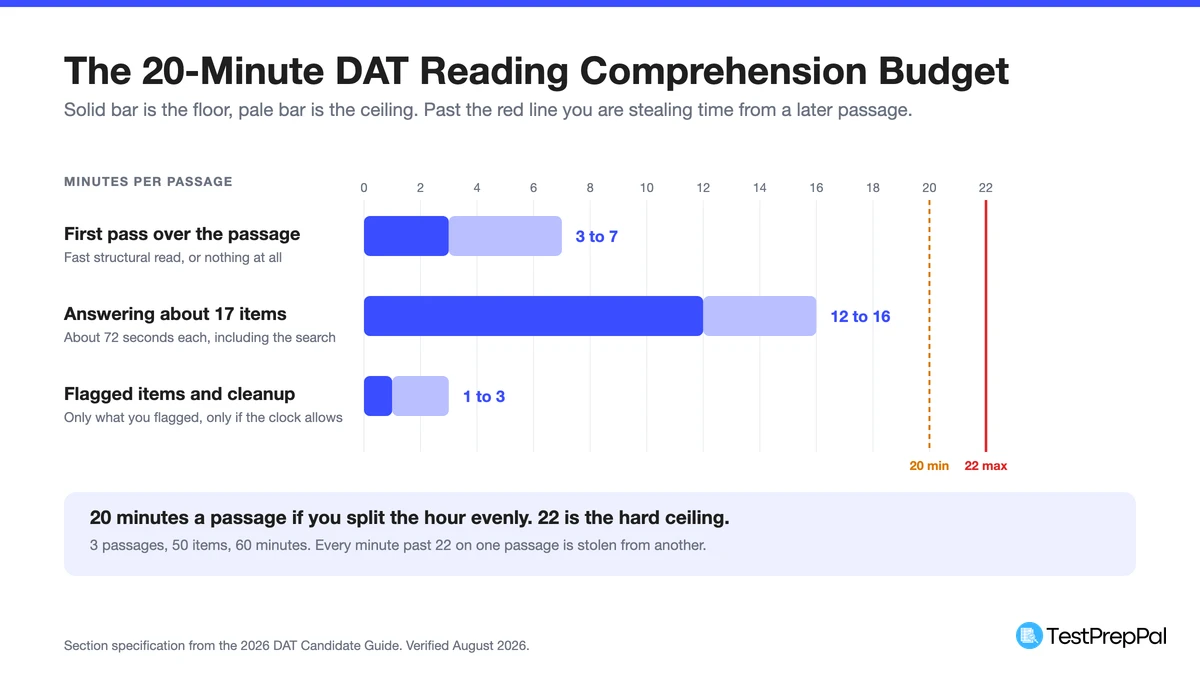 Solid bar is the floor, pale bar is the ceiling. Past the red line you are spending a later passage's time.
The Three Approaches, and When Each One Actually Wins
Nearly every DAT student is told there are three ways to attack a passage. Far fewer are told the conditions under which each one wins, which is the only part that matters.
Search and destroy
You read nothing first. You go to question 1, pull the distinctive noun out of the stem, scan the passage for it, read the two sentences around it, answer, and move on.
Wins when: you read dense science prose below roughly 200 words per minute, or you finish a passage and remember nothing from it. It also wins on any passage that is a list of facts with no argument.
Fails when: you hit main-idea, tone, and purpose items, because you have no passage in your head to answer them from. It fails badly, too, where a key term appears in four places and only one is right — you find a match, feel confident, and credit the wrong paragraph.
How to run it properly: answer the detail items in the order they come and defer every main-idea, tone, and purpose item to the end. By the time you have searched fifteen details you have effectively read the passage, and the big-picture items become easy. Answering the main-idea item first is the version that fails.
Map the passage
You read the passage once, fast, at the speed you would skim a news article, writing a two- or three-word label for each paragraph on your noteboard as you go. You are not trying to understand; you are building an index.
Wins when: you are a mid-speed reader, and on passages with an argument, a contrast, or a sequence of methods — which describes most DAT passages. It converts every detail item from a scan of 1,300 words into a scan of 110.
Fails when: your labels get long. A map is a lookup table, not notes.
How to build one in the time you have: one line per paragraph, two to three words, no verbs where you can avoid them. For the ice-core passage above, a good map is essentially:
| Para | Label |
|---|---|
| 1 | proxy vs. sample |
| 2 | firn close-off, gas age |
| 3 | dating by depth |
| 4 | volcanic + fallout markers |
| 5 | isotope thermometer, calibration doubt |
| 6 | CO2 and methane numbers |
| 7 | other proxies list |
| 8 | Antarctica vs. Greenland trade-off |
| 9 | abrupt warmings |
| 10 | contamination artifacts |
| 11 | deep ice disordered |
| 12 | cost, closing caveat |
That takes about 90 seconds to write and turns "where does it mention beryllium-10?" into a one-second lookup at paragraph 7. Note what the map does not contain: any of the actual content. You do not need to remember what the trade-off is, only that it lives in paragraph 8.
Read first
You read the whole passage carefully, then answer.
Wins when: you genuinely read dense prose at 250-plus words per minute with retention — a real ability, held by a minority of test takers. If you have it, this beats the others, because you answer inference, tone, and purpose items instantly and never re-read.
Fails when: you are not that reader and hope to become one under time pressure. Reading 1,300 words at 150 words per minute costs nine minutes, leaves 11 for seventeen items, and you will still be looking things up.
The honest test: run one passage on a timer with each approach, on different days, and compare score and elapsed time. Do not pick the approach that felt better; pick the one that scored better. Mapping beats both extremes for most students, which is why it is the default recommendation — but "most students" is not you, and this is worth three separate 20-minute experiments to settle.
Which one fits you
| If this describes you | Use |
|---|---|
| Slow reader, runs out of time every practice section | Search and destroy, big-picture items deferred to the end |
| Average speed, loses the thread by paragraph 8 | Map the passage |
| Fast reader with strong retention | Read first |
| Scores fine untimed, collapses on the clock | Map the passage — the map is what stops the re-reading |
| No idea | Map the passage, then test the other two against it |
Whatever you choose, commit before test day. Changing approach in the middle of a live section is the single most reliable way to lose a passage.
DAT Reading Comprehension Question Types: What Each One Is Really Asking
The section is overwhelmingly search-and-locate. Most items are answered by finding one sentence. The rest are answered by knowing what the passage is doing.
| Question type | What it is really asking | How to attack it | The trap |
|---|---|---|---|
| Detail / "according to the passage" | Which choice paraphrases one specific sentence? | Pull the most distinctive noun from the stem, find it, read the sentence before and after. | The right fact attached to the wrong subject — for example, an export that belongs to the cyanobacterial partner offered as the green algal one. |
| "In which paragraph" | Where does the passage establish this, not where does the word appear? | Find where the idea is defined, not where it is later reused. | A later paragraph that uses the term in passing sits higher in your scan than the paragraph that defined it. |
| Numerical detail | Which figure, with which units? | Locate the number, then check the units and what it counts. | Every wrong choice is a real number from elsewhere in the passage. A depth in meters gets offered as a concentration; a period in years gets offered as a range. |
| Main idea / purpose | What does the whole passage do? | Answer it last. Check the choice against the first and last paragraphs and against your paragraph map. | A true statement that covers only one paragraph. It is not wrong, it is narrow — and narrow is wrong here. |
| Inference | What must follow from the text, without adding anything? | Find the sentence the inference rests on. If you cannot point at one, it is not the answer. | An outside fact you happen to know. On this section, being right about the world and wrong about the passage scores zero. |
| Tone / attitude | How committed is the author? | Look for hedges — "disputed," "remains unclear," "may matter less." | Choices at the extremes. Scientific prose is almost never "dismissive" or "hostile," and an author who devotes a paragraph to a question is not "indifferent." |
| "The author would most likely agree" | Which statement is consistent with a position the author actually took? | Treat it as an inference item with a wider search radius: match the choice to a specific claim somewhere in the passage. | A reversed relationship. The passage says the anchors matter more than the models; the choice says the models matter more. |
| Function | Why is this sentence or example here? | Read what comes immediately before and after it. Function is always local. | Explaining what the example says instead of what it is doing. |
| Application | Can you run the passage's logic on a new case? | Find the paragraph where the passage handled the analogous case, and follow the same move. | A choice that names real passage content that is irrelevant to the new case. |
| Strengthen / weaken | Which new fact bears on the specific claim named in the stem? | Say the claim out loud in one sentence first, then ask which choice attacks or supports that sentence. | A choice that bears on a neighboring claim in the same paragraph. It feels relevant because it is on-topic. |
Two rules cover most of the misses here. First, the answer is in the passage — if you are reasoning from your biology coursework, you have already lost the item. Second, extreme language in a choice is usually disqualifying: "always," "never," "only," "cannot," and "invalidated" have to be matched by equally strong language in the text, and dense science prose rarely supplies it.
How to Use These Passages
- Do the first passage cold, on the clock, at 20 minutes. Note where you actually were at the 10-minute mark; most students find they are well behind their own estimate.
- Use the interface tools, because the real one has them. Highlight numbers and causal sentences, strike through eliminated choices, and flag anything that runs past 90 seconds.
- Sort your misses by type, not by passage. Four detail misses is a searching problem; four inference misses is a reading problem. Completely different fixes, and the explanations name the type for you.
- Read the explanation on the ones you got right too. Several items here are gettable by luck between two survivors, and the explanation tells you which one was actually supported.
- Do the second passage with a different approach. Map it if you searched, search it if you mapped. That comparison across two passages of equal difficulty is worth more than either score alone.
Keep Practicing
Read the full section breakdown — every question type, all four strategies, pacing, and scoring — in our guide to DAT Reading Comprehension.
Then work the rest of the exam: free DAT biology practice questions for the largest block of the Survey of the Natural Sciences, and free DAT quantitative reasoning practice for the 40-item QR section.
When you want to know what your section scores add up to, run them through the DAT score calculator, and turn the weeks you have left into an actual schedule with the DAT study plan generator.
For everything else that is free, see our roundup of free DAT resources.
We may earn commissions from some links on this page, but this does not affect our reviews or your experience.