

Free DAT PAT Practice
30 original questions across three of the six PAT question types — every figure drawn from its own geometry, every answer key computed rather than transcribed.
Keyhole (Apertures), Top-Front-End (View Recognition) and Pattern Folding (Spatial Relations) are not drilled here — all three depend on rotating a solid in three dimensions, which a static figure cannot test honestly. They are taught in full in the reference below the tool.
About This Free DAT PAT Practice
The Perceptual Ability Test is the section most students cannot study for in the ordinary sense. There is nothing to memorise. There are six fixed question types, 40 seconds a question, and a method for each type that either runs automatically or does not.
This tool drills three of those six types with 30 original questions, in a replica of the exam chrome — timer with pause, answer strikethrough, flag for review, a question navigator, and a full worked solution on every item.
| Set | What it trains | Questions |
|---|---|---|
| Angle Discrimination | Ranking four near-identical angles smallest to largest | 10 |
| Paper Folding (Hole Punching) | Mentally unfolding a punched sheet, including partial folds | 10 |
| Cube Counting | Counting painted faces on a cemented stack, hidden cubes included | 10 |
Every figure is drawn from stored geometry, not from a picture. The angle items store each angle's exact degree value and generate the rays trigonometrically, so the ranking comes from sorting. The paper-folding items store the fold sequence and punch coordinates and derive the unfolded pattern by reflecting each hole back through each fold in reverse. The cube items store integer coordinates and count, for every cube, how many faces have nothing cemented against them. No answer key here was typed by a human.
What this tool does not do. It does not drill Keyhole (Apertures), Top-Front-End (View Recognition) or Pattern Folding (Spatial Relations). All three require rotating a solid in three dimensions, and a flat figure whose answer we could not derive by construction would be worse than no practice at all. Those three are taught properly in the reference below.

How the Perceptual Ability Test Actually Works
The DAT is four tests taken in one five-hour-fifteen-minute appointment. The PAT is the second one, and it is the only section with no science content whatsoever.
| DAT section | Items | Time |
|---|---|---|
| Survey of the Natural Sciences | 100 | 90 min |
| Perceptual Ability Test | 90 | 60 min |
| Scheduled break (optional) | — | 30 min |
| Reading Comprehension | 50 | 60 min |
| Quantitative Reasoning | 40 | 45 min |
Section item counts and the administration schedule are from the ADA 2026 DAT Candidate Guide, verified August 28, 2026.
The ADA describes the PAT as six subtests and names them: Apertures, View Recognition, Angle Discrimination, Paper Folding, Cube Counting, and Spatial Relations / 3D Form Development. It publishes the 90-item total but does not publish a per-subtest item count in the current Candidate Guide; the long-standing structure students encounter is 15 items per type, which is also what 90 divided by six gives you. Plan on 15 and do not be thrown if a form feels uneven.
Two more things the ADA states outright and students routinely get wrong: you are not penalised for guessing, so no PAT item should ever be left blank, and some items are experimental and unscored, indistinguishable from the rest. A question that feels impossible may not even count.
How the PAT Is Scored
The PAT is reported as its own scale score — not a percentage, not a raw count. The ADA equates forms psychometrically so scores mean the same thing across test versions.
| PAT scoring fact | Detail |
|---|---|
| Scale | 200–600, in 10-point increments |
| Old scale | 1–30, retired March 1, 2025 (a concordance table exists) |
| Counts toward Academic Average? | No |
| Reported separately? | Yes — PAT appears on its own line of the score report |
| 2025 mean | 406.84 |
| 2025 standard deviation | 66.81 |
| 2025 reliability | .90 to .92 |
The Academic Average point is the one worth internalising. The ADA DAT User Manual defines it as the rounded arithmetic mean of Quantitative Reasoning, Reading Comprehension, Biology, General Chemistry and Organic Chemistry. The PAT is not in it. A weak PAT cannot drag your Academic Average down, and a strong one cannot prop it up — schools read the two numbers side by side. It also means the PAT is unusually easy to move: no content load, and a reliability of .90 to .92 says the score is a stable measurement of a trainable skill.
What a PAT Score Is Worth
Percentile standing computed from the frequency distribution published in the ADA DAT User Manual for March 1 through December 31, 2025 (17,430 examinations):
| PAT score | Approx. % of examinations below |
|---|---|
| 370 | 24% |
| 400 | 41% |
| 410 | 48% |
| 430 | 61% |
| 450 | 73% |
| 470 | 82% |
| 490 | 89% |
| 510 | 94% |
The Six PAT Question Types
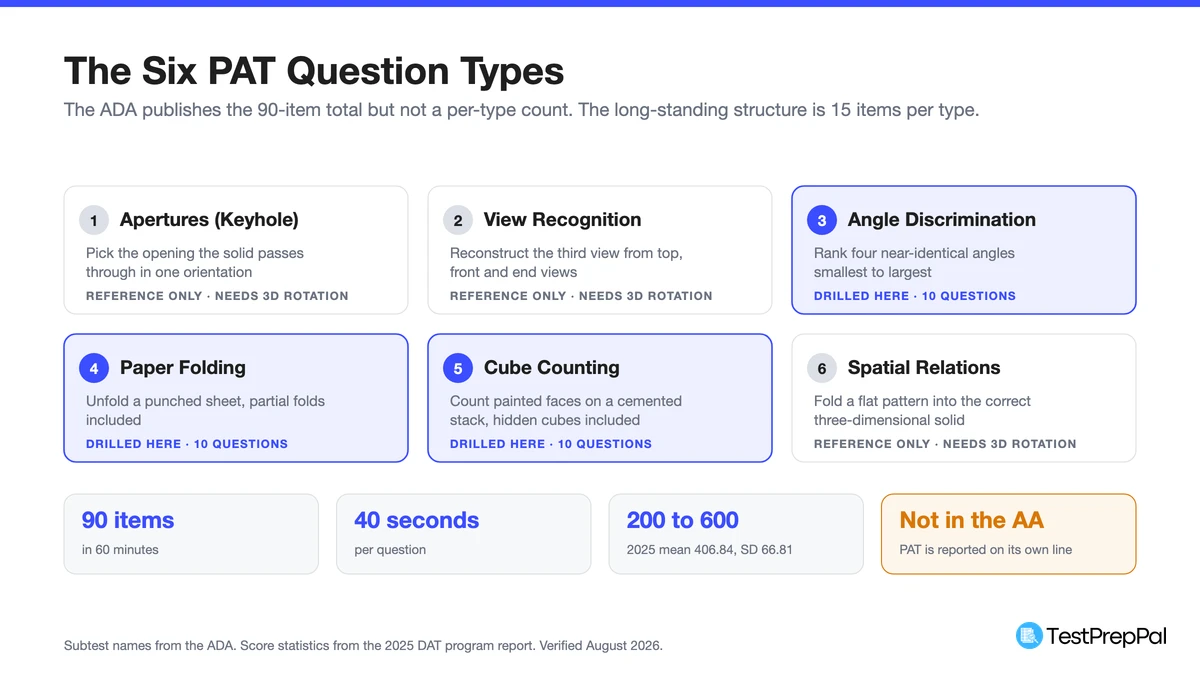 Three of the six can be rendered as exact geometry, so those are the three this tool drills. The other three are taught in full below.
The instructions below are our own summary of the rules the ADA publishes in its Perceptual Ability Test section instructions, verified August 28, 2026. Read the original before test day — the rules are the answer key.
1. Apertures (Keyhole)
The task. A three-dimensional object, then five openings. Pick the one opening the object could pass completely through if the correct side went in first.
The rules that decide it. You may turn the object any way you like before it enters the opening, but not once it has started through. The opening is always the exact outline of one of the object's silhouettes. Objects and openings are drawn to the same scale, so an opening can be the right shape and still be too small. Hidden parts contain no surprises, and a symmetric indentation stays symmetric behind. Exactly one opening works.
The attack. Check one dimension at a time. Take the object's width, then its height, then its depth, and eliminate any opening too small in that one dimension before you think about shape at all. Only then compare outlines. Most students lose these by trying to visualise the whole rotation at once instead of running three cheap eliminations.
The classic trap. An opening that is the perfect silhouette but slightly undersized. The ADA says explicitly that differences are large enough to judge by eye — which means when two openings look like the same shape, size is the thing being tested.
2. View Recognition (Top-Front-End)
The task. Two of the three orthographic views of a solid are given; pick the missing one from four options.
The rules that decide it. The views are parallel projections with no perspective. Top view sits upper-left, front view lower-left, end view lower-right, always in those positions. A line that cannot be seen on the surface in a given view is drawn dotted in that view. And it is not always the end view you have to supply — sometimes the missing panel is the top or the front.
The attack. The dashed-versus-solid rule is the whole game. A solid line is a visible edge; a dotted line is an edge hidden behind material. Work from the two given views to the number of steps, notches or holes in the solid, then check each choice for whether every hidden feature is dotted and every visible one solid.
The classic trap. Choices that are geometrically right but use the wrong line type — often differing only in whether one internal line is dashed. Check line type before shape.
3. Angle Discrimination
The task. Four labelled angles; rank them smallest to largest.
The attack. Do not try to rank all four at once. Find the obvious extremes first — the clear smallest and the clear largest — and lock them in. Because the four answer choices only ever differ by swapping the first pair or the last pair, fixing one end of the ranking eliminates half the options immediately. Then make one comparison: the pair you are actually unsure about.
For acute angles, look at the vertex, not the ray tips: judge how quickly the two lines separate in the first fraction of their length. For obtuse angles the vertex tells you nothing, so switch methods — imagine folding one ray onto the other and judge which angle needs the least folding to lie flat.
The classic trap. Second-guessing. First instinct beats deliberation on angles, and every extra second here is stolen from a subtest where thinking actually helps.
4. Paper Folding (Hole Punching)
The task. A square is folded one or more times, then punched. Choose the hole pattern on the unfolded square.
The rules that decide it. Dashed lines show the original square; solid lines show the folded paper. The paper is never turned or twisted, and the folded sheet always stays inside the original square.
The attack. Count thicknesses before you look at the choices. One punch through n thicknesses gives 2ⁿ holes, so a full half-fold twice means four holes and three times means eight. Getting the count first eliminates most answer choices without any spatial reasoning at all. Then unfold in reverse order — the last fold first — and mirror the holes across that fold line each time.
The classic trap. Partial folds. When a fold turns over only a strip rather than a half, part of the sheet is still a single thickness, and a punch out there does not double. Two of the ten items in this tool are built exactly that way. Count thicknesses per punch, not per item.
5. Cube Counting
The task. A figure built from cemented cubes, painted on every exposed surface except the bottom it rests on. You are asked how many cubes have exactly N painted sides.
The rules that decide it. No cube can have more than five painted faces, because the bottom face is always cemented or resting. The only hidden cubes are the ones required to hold up cubes you can see — so you never invent a cube, and you never omit one that something is standing on. And zero is never the correct answer.
The attack. Do not answer the question that was asked. Tally the whole figure once: write 1, 2, 3, 4, 5 on your board and tick a mark for each cube's painted count, then read your answer off the tally. It is barely slower than counting one category, it self-checks (ticks must equal cube count), and if the item asks two questions about the same figure the work is already done.
The classic trap. The back cube you cannot see. In a two-by-two base with something stacked on it, one base cube is screened on the right, on the left and on top — invisible, and often the only cube with a low painted count.
6. Spatial Relations (Pattern Folding)
The task. A flat pattern, then four solids. Pick the solid the pattern folds into.
The attack. Do not fold the whole net. Pick one distinctive face — the most unusual shape, shading or marking — and track only that face. Establish which faces are adjacent to it in the flat pattern, then check each candidate solid: if a face that should touch your marker face does not, the solid is out. Adjacency survives folding; orientation is far harder to reason about.
The classic trap. Mirror images. Two candidate solids can have identical faces in identical adjacencies but opposite handedness. When two choices survive your adjacency check, the difference is chirality — pick the one whose shaded faces run in the same rotational direction as the net.
How to Use This Tool
Work one type at a time. Mixed practice feels productive and is the slowest way to improve, because each PAT type has its own method and switching between them costs the reps that build automaticity.
- Run one set untimed and read every solution, including the ones you got right. The solutions state the geometry — exact degrees, the fold-by-fold unfolding, the full painted-face tally — so you can check whether you were right for the right reason.
- Repeat the same set until the method runs without deliberation.
- Only then add the clock, and only then move to the mixed set.
Pacing. 40 seconds a question is the average, not the target for every type. Angles and cube counting are fast; keyholes and pattern folding are slow. Budget 25 to 30 seconds on the angles and spend the surplus on the two rotation-heavy types. The tool reports your seconds per question at the end of each set.
On guessing. There is no penalty. If an item is not resolving in about 55 seconds, take your best remaining option, flag it and move. One abandoned item costs one point; running out of time costs every item you never reached.
Keep Practising
The biggest PAT gain is repetition with feedback; the second biggest is knowing the rules well enough that they do the work for you. Read the DAT Perceptual Ability Test guide for the study-plan side, then keep the rest of the exam moving with free DAT biology practice questions and free DAT quantitative reasoning practice — the two sections that do feed the Academic Average.
To translate practice performance into the 200–600 scale, use the DAT score calculator; to build the weekly schedule around whichever section is furthest behind, use the DAT study plan generator. Everything else we have for this exam is on the free DAT resources page.
We may earn commissions from some links on this page, but this does not affect our reviews or your experience.