

Free DAT Organic Chemistry Practice Questions
30 discrete questions across 4 topic sets — matching the 30 organic chemistry items on the Survey of the Natural Sciences, in the DAT test interface
About These Free DAT Organic Chemistry Practice Questions
These 30 free DAT organic chemistry questions run inside a replica of the DAT test interface — one question at a time, with answer strikethrough, flag for review, question navigation, and a running timer. The count is not arbitrary: the real Survey of the Natural Sciences contains exactly 30 organic chemistry items, so this is a full-length organic block.
Unlike the MCAT, DAT organic chemistry is entirely discrete — there are no reading passages anywhere in the Survey of the Natural Sciences. Every question stands alone, which changes how you pace: you never get to amortize a slow read across four items, and there is no passage to hunt in for a value you forgot.
Every item here is written to be solved from IUPAC names, condensed formulas, and tabulated data rather than from a drawn structure. That is a harder constraint than the real exam imposes, and it is deliberate. If you can predict a methyl shift from the name 3,3-dimethyl-2-butanol alone, you will not be slowed down when the exam hands you the picture.
| Set | ADA topic category | Questions |
|---|---|---|
| Structure, Nomenclature & Stereochemistry | Structural Evaluation | 8 |
| Substitution, Elimination & Reaction Mechanisms | Mechanisms | 8 |
| Functional Group Reactions & Synthesis | Chemical Synthesis | 7 |
| Acid–Base, Spectroscopy & Lab Techniques | Acid-Base Chemistry + Chemical & Physical Properties | 7 |

How Much Organic Chemistry Is on the DAT?
Organic chemistry is 30 of the 100 items in the Survey of the Natural Sciences — the same weight as general chemistry, and three-quarters the weight of biology. It appears in no other section.
| DAT section | Items | Time |
|---|---|---|
| Survey of the Natural Sciences | 100 | 90 minutes |
| — Biology | 40 | (shared) |
| — General Chemistry | 30 | (shared) |
| — Organic Chemistry | 30 | (shared) |
| Perceptual Ability Test | 90 | 60 minutes |
| Reading Comprehension | 50 | 60 minutes |
| Quantitative Reasoning | 40 | 45 minutes |
The Survey of the Natural Sciences is a single 90-minute block. The ADA does not fence off the three subjects, so 100 items in 90 minutes means roughly 54 seconds per question, and about 27 minutes for organic chemistry if you split the time proportionally. Total administration time is five hours and 15 minutes including the optional tutorial, the optional 30-minute scheduled break, and the optional post-test survey.
Three more facts that change how you prepare:
- No calculator, no reagent sheet. A digital calculator is available only in Quantitative Reasoning. An on-screen periodic table is provided for the General Chemistry portion. Nothing is provided for organic chemistry.
- No penalty for guessing. Answer every item. Some questions on each form are unscored experimental items and look identical to scored ones.
- Scores run 200 to 600 in 10-point increments. The old 1-to-30 scale was retired on March 1, 2025.
Section counts, timing, scoring, and guessing policy are from the ADA 2026 DAT Candidate Guide (updated 08/04/2026) and the official DAT program page, verified August 28, 2026.
Reaction Roadmap, Stereochemistry, and IR/NMR Tables
The full reagent roadmap, the stereochemistry and nomenclature reference, and the IR and ¹H NMR shift tables now live in one place: our guide to DAT organic chemistry. Nothing of the sort is handed to you on test day, so work those tables until you can reproduce them from memory rather than merely recognize them. Then come back here and retake the set at 54 seconds per question.
What the ADA Actually Tests
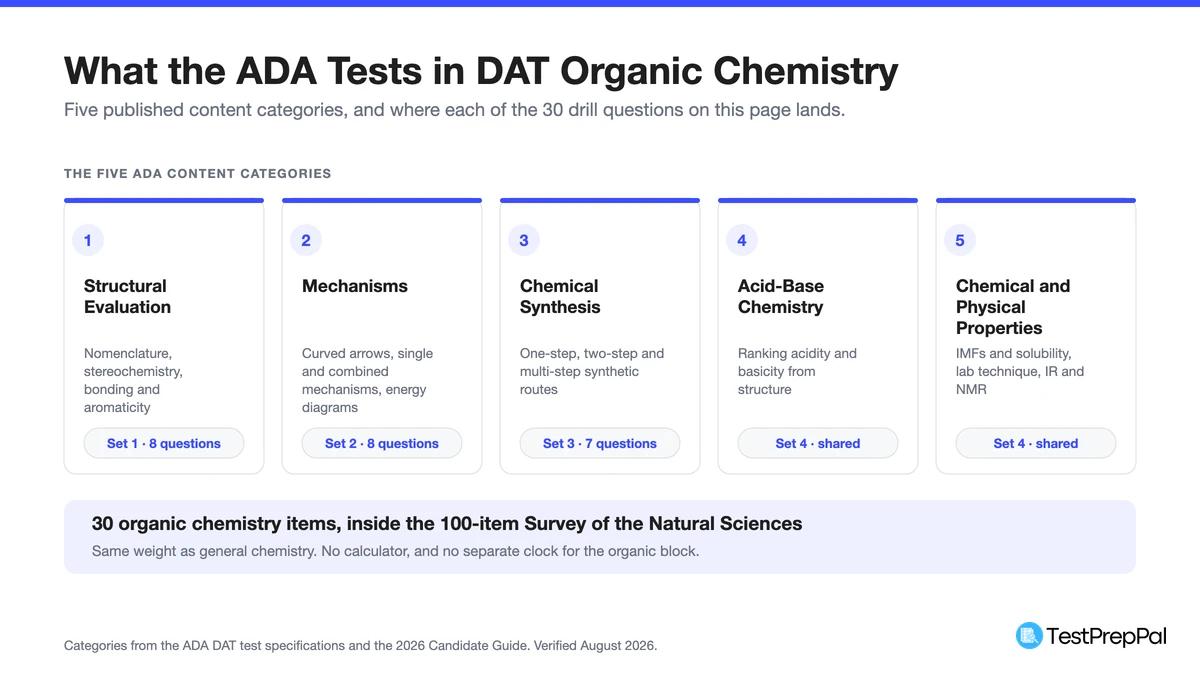 The five published categories, and which of the 30 questions above covers each one.
The organic chemistry specifications were updated with an anticipated implementation date of April 2026. The ADA describes the change as renaming topics to be simpler and more intuitive and adding a fuller list of subtopics — not a change in the content that appears on the exam. Here are the five current categories and where each is drilled above.
| ADA category | Subtopics | Set |
|---|---|---|
| Mechanisms | Curved arrows; single mechanisms (resonance, free radical, proton transfer, addition, elimination, substitution, rearrangements, other); combined mechanisms; reaction coordinate diagrams | Set 2 |
| Chemical Synthesis | One-step (SN1/SN2, E1/E2, alkenes/alkynes, alcohols, ethers and epoxides, radicals, aromatics, carboxylic acids and derivatives, ketones and aldehydes, α-carbonyl compounds); two-step; multi-step; reactivity across functional groups | Set 3 |
| Acid-Base Chemistry | Ranking acidity/basicity across functional groups; structure analysis (charge, size, electronegativity, resonance, inductive effect, hybridization, sterics); prediction of products and equilibria | Set 4 |
| Chemical & Physical Properties | Structure (polarity, intermolecular forces, solubility, melting/boiling point); laboratory theory and techniques (chromatography, extractions, recrystallization, distillation); spectroscopy (¹H NMR, ¹³C NMR, infrared, multi-spectra) | Set 4 |
| Structural Evaluation | Nomenclature (functional groups, IUPAC rules); stereochemistry (conformations, isomer relationships, chirality); structure and bonding (aromaticity, hybridization, resonance, orbitals, bond angles and lengths, relative stability) | Set 1 |
Topic list from the ADA NEW Organic Chemistry Examination Specifications, verified August 28, 2026. Confirm the specifications in effect on your own test date before you build a study plan around them.
How to Use These Practice Questions
- Name the mechanism before you read the choices. Almost every DAT organic item reduces to one question: what is the nucleophile, what is the electrophile, and what leaves? Getting that far usually kills two answers outright.
- Check for rearrangement whenever a carbocation forms. If the cation is secondary and sits next to a tertiary or quaternary carbon, a hydride or alkyl shift is coming. Questions built on this — like the dehydration item in set 2 — reward the students who look, every time.
- Read the base, not just the substrate. Zaitsev versus Hofmann is decided by whether the base is small or bulky. The substrate tells you E2 is happening; the base tells you which alkene you get.
- Treat pKa as a comparison, never a number. You are rarely asked for a value. You are asked whether one species can deprotonate another, and the reaction runs if the acid being deprotonated is stronger than the conjugate acid formed.
- Use spectra to eliminate first. A band at 1710 with a very broad 2500–3300 absorption does not merely suggest a carboxylic acid; it excludes ketones, esters, and alcohols in a single step.
- Read every explanation, including on the ones you got right. Each solution names the specific distractor logic the exam reuses — and on a 54-second-per-question section, recognizing a trap is faster than reasoning past it.
Keep Practicing
Cover the rest of the Survey of the Natural Sciences with our DAT biology practice questions, then work the other timed sections with our DAT quantitative reasoning practice.
When you have a raw score, put it in context with the DAT score calculator, and turn the weeks you have left into a real schedule with the DAT study plan generator.
For the strategy side of this subject — how to sequence mechanisms, when to switch to timed mixed blocks, and what the 2026 specification update actually changed — read our full guide to DAT organic chemistry. For everything else that costs nothing, see our roundup of free DAT resources.
We may earn commissions from some links on this page, but this does not affect our reviews or your experience.